Why Species Counts Aren’t Enough: The Power of Functional Diversity in Ecosystem Science
Awais Rasool
May 18, 2026

Why only Species Counts Aren’t Enough?
For decades, ecologists and conservationists have used species richness — the simple count of different species in an area — as the primary measure of biodiversity. While intuitive and relatively easy to measure, this approach often falls short when trying to predict how ecosystems will respond to environmental changes, species loss, or restoration efforts.
A landmark 2011 paper by Marc Cadotte and colleagues, titled "Beyond species: functional diversity and the maintenance of ecological processes and services" (published in Journal of Applied Ecology), made a compelling case for shifting focus to functional diversity (FD). This concept emphasizes the variety of functional traits that species possess — characteristics like leaf size, root depth, nitrogen-fixing ability, feeding habits, or dispersal mechanisms — that directly influence ecosystem processes.
What Is Functional Diversity?
Functional diversity goes beyond “who is there” to answer “what do they do?” It captures three main components:
Functional richness: The range of different trait values present in a community.
Functional evenness: How evenly the abundance is distributed among those traits.
Functional divergence: How species’ traits differ from the community average in terms of their contribution to ecosystem processes.
These components better reflect the niche complementarity and selection effects that drive ecosystem functioning.
Why Functional Diversity Outperforms Species Richness
Cadotte et al. reviewed multiple studies and demonstrated that functional diversity metrics consistently explain more variation in ecosystem functions (such as productivity, nutrient cycling, pollination, and decomposition) than species richness alone.
Key reasons include:
Redundancy and Insurance: Many species may perform similar roles (redundancy). Losing one may have little impact if others fill the same niche. Functional diversity reveals when critical roles are truly threatened.
Trait Complementarity: Different traits allow species to use resources more efficiently together (e.g., deep-rooted and shallow-rooted plants accessing different soil layers). This complementarity often drives higher productivity and stability.
Response to Environmental Change: Species with different traits respond differently to stressors like drought, pollution, or warming. High functional diversity increases resilience.
Better Prediction of Services: Ecosystem services (clean water, carbon storage, food production, pest control) depend more on what organisms do than on how many species are present.
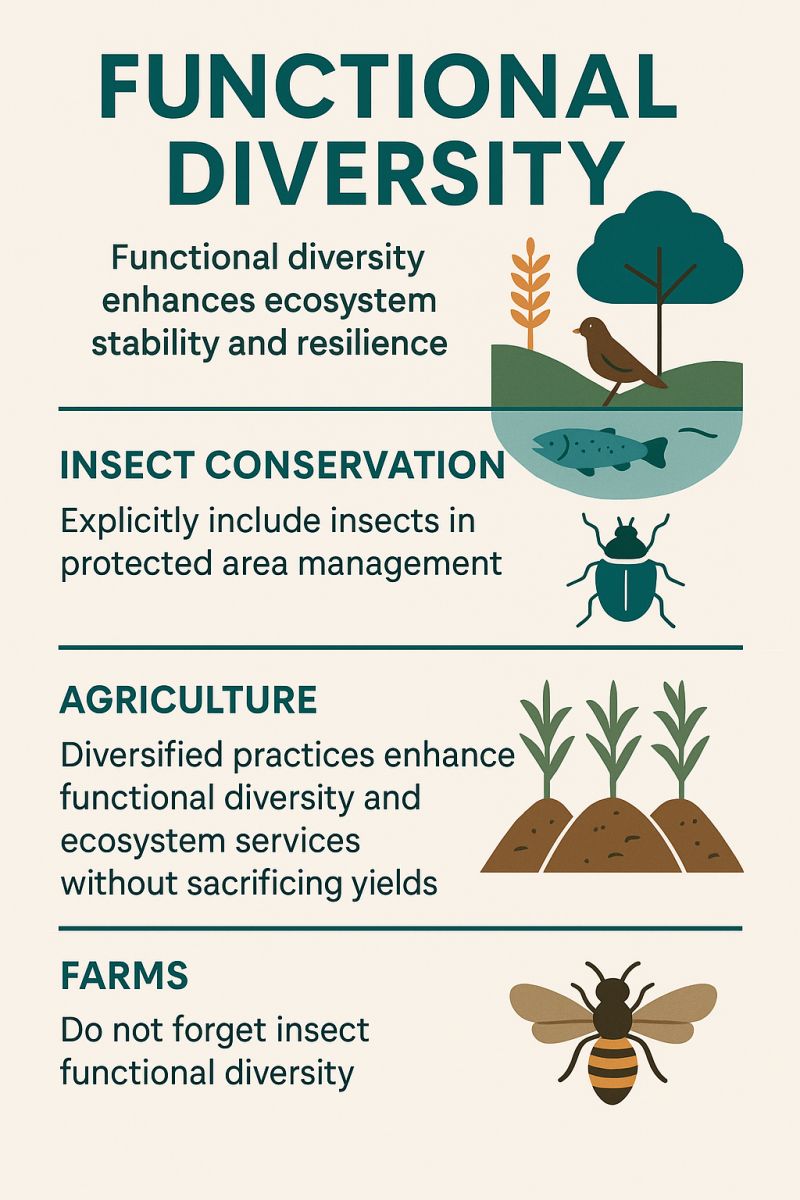
Real-World Evidence and Case Studies
Grassland Experiments: In many biodiversity-ecosystem functioning (BEF) experiments, plots with high functional diversity showed greater biomass production and better nutrient retention than high-richness but functionally similar communities.
Restoration Projects: Restoration efforts that select species based on functional traits (e.g., mixing nitrogen-fixers, deep-rooted perennials, and fast-growing pioneers) achieve faster and more stable recovery than those based solely on maximizing species numbers.
Pollination Services: Diverse pollinator communities with varied mouthparts, flight periods, and temperature tolerances provide more reliable and efficient pollination than species-rich but functionally similar assemblages.
Urban and Agricultural Systems: Studies in urban greenspaces and farmlands consistently show that functional trait diversity in plants and soil organisms better predicts carbon sequestration, water infiltration, and soil fertility.
Later empirical work (including global urban studies and trait-based analyses) has reinforced these findings: trait-based indices often explain 20–50% more variation in ecosystem functions than taxonomic diversity alone.
Implications for Conservation and Management
Adopting a functional diversity lens changes how we approach:
Prioritization: Protect or restore species that fill unique functional roles (keystone or “foundation” species) rather than just maximizing checklists.
Monitoring: Track functional metrics alongside species counts for more meaningful indicators of ecosystem health.
Climate Adaptation: Design communities with trait portfolios that can withstand projected changes (e.g., drought-resistant traits in water-stressed regions).
Policy and Offsetting: Biodiversity offsets and nature-based solutions become more effective when functional equivalence is considered.
Challenges and Limitations
Functional diversity is not perfect. It requires detailed trait data, which can be expensive or incomplete for many taxa (especially microbes and insects). Choosing which traits to measure also involves judgment. Additionally, some rare species with low functional contribution may still have cultural, ethical, or evolutionary value.
Despite these challenges, the benefits far outweigh the costs, especially as trait databases (such as TRY, BIEN, and others) continue to expand.
The Road Ahead
The shift from species counts to functional diversity represents a maturation of ecological science — moving from pattern description to mechanistic understanding. As we face accelerating global change, this approach equips us with better tools to predict outcomes, design resilient ecosystems, and secure the services upon which human societies depend.
Future research integrating functional diversity with complex adaptive systems thinking, advanced modeling, and economic valuation will further strengthen our ability to manage ecosystems wisely.