Why every bird’s nest deserves our attention, The Small Architecture of Survival.
Muqadas Mukhtar
July 19, 2026
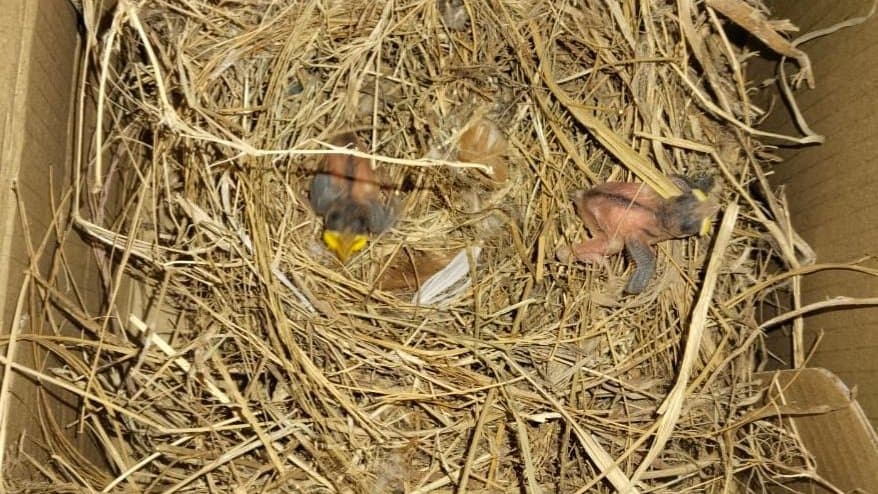
Go into any town in Pakistan, under any tree, under any ledge or on the edge of any roof eave and you will find one: a cup of dry grass; a wedge of twigs stuck in a drainpipe; a woven dome hanging from a thorn branch. We only become aware of nests when they obstruct the way, e.g. blocking a gutter, straw falling on a balcony, and they are normally not what they appear to be: litter, just as litter boxes are often not litter.
Eggs do not necessarily lay in a nest. It’s an under pressure decision with virtually no margin for error, made by an animal.
A Nest Is a Bet on the Future
Each nest is a bird’s best guess of where their chicks will have the lowest chance of death. That guess must include predation, weather, food availability, nest-site competition, and material availability and is in a landscape that the bird chose and does not control. A House Sparrow using a small space behind an air conditioner to make a nest; a Bank Myna pecking away at the wall of a canal to make a burrow; a Baya Weaver braiding a hanging basket from paddy leaves all are figuring it out in very different ways, all using tools that evolution has honed with generations of trial and error.

This is one of the most sensitive indicators ecologists have because of this reason. It is not a random process when a species begins to nest at a new location or ends nesting at an old location. It can be a sign that there is some change in the landscape building materials, trees, predators, food, noise, light. The nest is a bird’s report card on the neighborhood.
What is the cost of a missing nest?
Easy to imagine one lost nest as a minor occurrence – one clutch, a few eggs, easy to replace next season. One of the most constraining steps in a bird’s life cycle is its chances of nesting successfully. The adult birds are not very fragile. A healthy adult sparrow or bulbul could live through a bad year. Eggs and nestlings are unable to. The nest, not only the eggs in it, but the nest itself is the one most vulnerable spot in the annual survival of a bird, as it is stationary, dependent, and exposed for weeks at a time.
Scale that up to a population and we see the pattern: A city that doesn’t advocate the removal of cavity sites, the installation of solid aluminium window frames, the removal of old trees with hollow limbs, doesn’t kill birds directly. It simply makes it increasingly difficult to produce them and over 10 years a species that was once abundantly present becomes locally rare and, in many cases, it is only then that someone realizes that something is going wrong and that the culprit is the decline of the fish stock.
The nesting materials are its own crisis of silence.
There is a lot of discussion about nesting places, and nesting materials should be given the same treatment. Stiff, sturdy grass and fibre make a good nest that will stay intact in all weather conditions and as the chicks grow. A nest constructed from any shreds and shavings that can be found in a material-poor urban situation is a shaky gamble. In urban areas, where natural ground cover and hedgerows and weeds have been removed, birds may have to use inferior materials because there is no better material within flying distance to use as a building site.
Changing landscapes and habitat removal is one of the hidden costs of urbanization, not only because it eliminates places to nest but also because it subtly affects the nest-building supplies that can lead to a successful nesting season.
The ripples spread out beyond the birds.
Birds’ nests are also accidental assets of other species. Other birds, rodents and insects re-use old nests. Nesting colonies cause nutrient concentrations in a specific location and affect soil and plant development under the colonies. Cavity nests started by one species are frequently taken over by another the following year. When you remove the nest, or the tree or ledge where one was built, you aren’t only removing one bird’s breeding attempt; you are removing a resource that an entire small web of species may have relied on often without being noticed!
There’s also the less tangible cost of erosion of an early-warning system, which is slower. Birds are well known for their responsiveness to environmental changes and one of the more easily observed clues to these changes is in their nesting behavior: where they nest, when they nest, and how successful they are. If the sparrows are still nesting in your eaves and the myna still nesting in your drainpipes, you are telling yourself something: That there’s still enough structural, material generosity in your neighborhood for life to exist that isn’t human.
What this ACTUALLY asks of us
No big conservation moves are necessary. It is asking for a lot less and yet a lot more mundane: to leave behind an old tree with hollow limbs instead of cutting it down for tidiness, not to trim a hole in an eave the instant it opens, not to pour concrete in a space of ground still too wild and weedy for the neighbors, not to lop a hedge after nesting season. These are not sexy, high dollar options, not ones that will find their way into a conservation news story, but exactly the sort of decisions that make or break a birds’ choice of nesting location.
The next time you see that unattractive collection of grass and twigs stuck in a gutter or on a ledge, do not automatically think “dirty. In miniature, it is the question of whether that species can continue to exist in that particular corner of the world whether it can continue to exist in that particular corner of the world for one more season whether it continues to exist in that particular corner of the world at all.