Where Are Your Organs Located? The Complete Body Map Guide
AIMAN
August 19, 2026
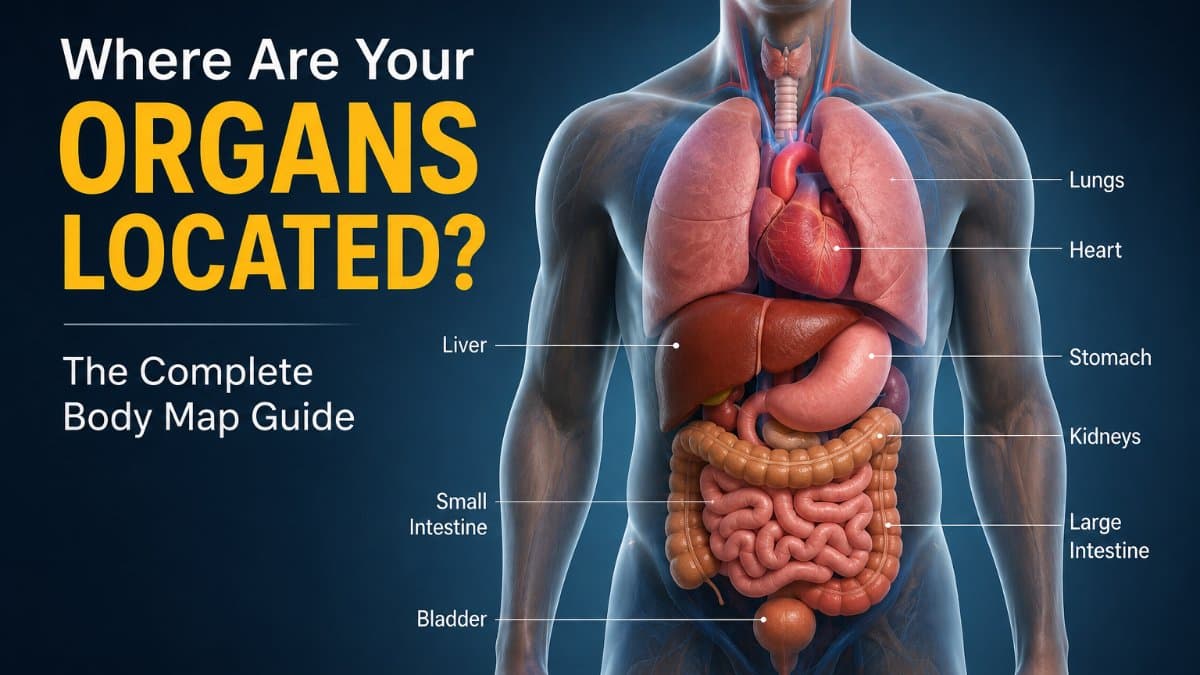
Where Are Your Organs Located? The Complete Body Map Guide
Your organs are grouped by region: the heart and lungs sit in the chest, the stomach, liver, spleen, and pancreas sit in the upper abdomen, the intestines and bladder sit in the lower abdomen and pelvis, and the kidneys sit toward the back on both sides.
Most people can name their major organs without much trouble — heart, lungs, liver, kidneys. But knowing where each one actually sits inside your body is a different skill, and it's one that matters more than people expect. Whether you're trying to understand a symptom, studying anatomy, or just curious, having an accurate mental map of your organs makes it easier to understand your own body and communicate clearly with a doctor when something feels off.
This guide walks through every major organ region by region, from the chest down to the pelvis, and explains how the left and right sides differ. This article is for general anatomy education only. It is not medical advice, and it isn't meant to diagnose symptoms — if you're experiencing pain, talk to a healthcare provider.
How the Body Is Organized Into Regions
Anatomists and doctors don't think about organ location randomly — they use consistent regions to describe where things are. Understanding these regions is the fastest way to build a mental map of your own body.
Thoracic region (chest): protected by the rib cage, houses the heart and lungs
Upper abdomen: contains most of the digestive organs — stomach, liver, spleen, pancreas
Lower abdomen and pelvis: contains the intestines, bladder, and reproductive organs
Back and flank: the kidneys sit here, toward the rear of the body rather than the front
Doctors also divide the abdomen into four quadrants — right upper, left upper, right lower, and left lower — to describe pain location precisely. We'll use this quadrant system throughout this guide, since it's the most practical way to talk about organ location.
Organs in Your Chest (Thoracic Region)
The chest cavity is protected by the rib cage and separated from the abdomen by the diaphragm, a dome-shaped muscle used in breathing.
Heart The heart sits roughly in the center of the chest, slightly tilted toward the left side. This slight lean is why people often feel their heartbeat more strongly on the left.
Lungs The lungs fill most of the chest cavity on both sides. The right lung is slightly larger and has three lobes, while the left lung has only two, making room for the heart.
Esophagus The esophagus runs down the center of the chest, connecting the throat to the stomach. It passes just behind the heart before reaching the diaphragm.
Organs in Your Upper Abdomen
Just below the diaphragm, the upper abdomen holds most of your major digestive organs. This region is further split into the right upper quadrant and left upper quadrant.
Right Upper Quadrant
Liver — the largest internal organ, sitting mostly on the right side under the ribs, responsible for filtering blood and processing nutrients
Gallbladder — a small sac tucked under the liver that stores bile used in digestion
Right kidney (upper portion) — partially protected by the lower right ribs
Left Upper Quadrant
Stomach — sits mostly on the left side, breaking down food with acid and enzymes
Spleen — positioned high on the left side, filtering blood and supporting immune function
Pancreas — stretches horizontally across the upper abdomen, with its tail reaching toward the left
Left kidney (upper portion) — partially shielded by the lower left ribs
If you're specifically interested in what's on one side, our detailed guides on [what organs are on your left side] and [what organs are on your right side] break each of these down further by sub-region.
Organs in Your Lower Abdomen and Pelvis
Below the upper abdomen, the lower abdomen and pelvis contain the intestines, bladder, and reproductive organs. This region is divided into the right lower quadrant and left lower quadrant.
Right Lower Quadrant
Appendix — a small pouch attached to the large intestine, located in the lower right abdomen
Cecum — the beginning of the large intestine, where it connects to the small intestine
Right ovary and fallopian tube — present in women, located in the lower right pelvis
Left Lower Quadrant
Descending colon — carries waste down the left side of the abdomen
Sigmoid colon — the curved section connecting the descending colon to the rectum
Left ovary and fallopian tube — present in women, located in the lower left pelvis
Central Pelvic Organs
Bladder — sits low and central in the pelvis, storing urine before it's released
Rectum — the final section of the large intestine, located centrally at the base of the pelvis
Uterus — in women, positioned centrally above the bladder
Organs in Your Back and Flanks
Not every organ sits toward the front of the body. A few important ones are positioned toward the back, which is a common source of confusion.
Kidneys Both kidneys sit toward the back of the abdominal cavity, roughly at waist level, rather than the front like most digestive organs. This is why kidney-related pain is often felt in the back or flank rather than the front of the abdomen.
Adrenal Glands Small glands that sit directly on top of each kidney, producing hormones that regulate stress response, metabolism, and blood pressure.
Portions of the Colon The ascending and descending sections of the large intestine run along the back-right and back-left portions of the abdominal wall, respectively.
Left Side vs. Right Side: Full Comparison
Because so many people search specifically for left-side or right-side organ location, here's a direct side-by-side comparison across all major regions.
Notice that the left and right sides aren't mirror images of each other — the liver and appendix don't have a matching organ on the opposite side, while paired organs like the kidneys and lungs exist on both.
How Doctors Use the Quadrant System in Practice
The four-quadrant system isn't just an academic tool — it's how abdominal pain gets triaged in real clinical settings. When you describe pain by quadrant, a doctor can immediately narrow down a shortlist of likely organs before running any tests.
Right upper quadrant pain often points toward the liver or gallbladder, especially if it's linked to fatty meals.
Left upper quadrant pain often points toward the stomach, spleen, or pancreas.
Right lower quadrant pain is the classic location associated with the appendix.
Left lower quadrant pain is more often associated with the descending or sigmoid colon.
This is also why a doctor will typically press on different quadrants during a physical exam — each quadrant has a distinct set of possible sources, and location alone can rule several of them in or out before any imaging is even ordered.
The Digestive System's Path Through the Abdomen
One helpful way to understand organ location is to trace the digestive system's actual path through the body, since it touches almost every abdominal region in sequence:
Esophagus — carries food down through the chest to the stomach
Stomach — left upper quadrant, breaks food down with acid
Small intestine — coils through the central abdomen, absorbing nutrients
Large intestine (ascending colon) — travels up the right side
Large intestine (transverse colon) — crosses the upper abdomen from right to left
Large intestine (descending colon) — travels down the left side
Sigmoid colon and rectum — central-lower pelvis, the final stretch before elimination
Tracing this path explains why digestive symptoms can shift location as food moves through the system — cramping that starts centrally and moves toward the lower right or lower left is often just following this same route.
Circulatory and Filtration Organs
Beyond digestion, several organs are responsible for filtering blood and maintaining fluid balance. These are worth understanding separately since their symptoms often feel different from digestive discomfort.
Heart Beyond its central chest position, the heart connects to major blood vessels that run through both the chest and abdomen, which is part of why cardiac symptoms can occasionally be felt outside the chest itself.
Kidneys Positioned toward the back on both sides, the kidneys filter waste from the blood and regulate fluid balance. Because they sit deep and toward the rear, kidney-related discomfort is typically felt as a dull ache in the flank or lower back rather than a sharp pain in the front.
Spleen While often grouped with digestive organs because of its location, the spleen is actually part of the circulatory and immune systems, filtering blood and recycling old red blood cells rather than processing food.
Liver In addition to digestion-related functions like bile production, the liver plays a major role in filtering toxins from the blood and storing nutrients, making it one of the most metabolically active organs in the body.
Step-by-Step: How to Visualize Your Own Organ Map
If you want a simple mental model you can actually remember, try this approach:
Divide your torso into a grid — picture a horizontal line at your ribs and another at your belly button, plus a vertical line down the center.
Place the chest organs above the rib line — heart centered, lungs on both sides.
Place the digestive organs in the upper squares — liver and gallbladder upper right, stomach and spleen upper left.
Place the elimination and reproductive organs in the lower squares — appendix lower right, colon lower left, bladder and rectum centered.
Add the kidneys as a separate back layer — mentally place them behind the upper squares, not within them.
This five-step mental grid mirrors exactly how clinicians think about the abdomen, and it's far easier to recall under stress (like when you're trying to describe a symptom) than a list of individual organs.
Why Some Organs Only Exist on One Side
A common question once people start mapping their organs is why the layout isn't symmetrical. The answer comes down to how organs developed and how they function:
Paired organs (lungs, kidneys, adrenal glands, ovaries) exist on both sides because the body benefits from redundancy or bilateral function.
Single central organs (heart, stomach, bladder) sit in one place because there's no functional need for a duplicate, though they may lean slightly left or right.
Asymmetrical single organs (liver, spleen, appendix) developed on one side specifically because of how the digestive and circulatory systems are structured during fetal development.
This asymmetry is completely normal and is the same in every healthy person — it's simply how the human body is built.
How to Use This Body Map in Everyday Life
Understanding organ location isn't just academic. Here's how it's actually useful:
Describing symptoms accurately — telling a doctor "upper right, under the ribs" is far more useful than "my stomach hurts," and can speed up diagnosis.
Understanding test results — imaging reports (ultrasounds, CT scans) often reference quadrants and regions directly, so knowing the map helps you follow along.
Recognizing when something is unusual — a baseline understanding of your own anatomy makes it easier to notice when a sensation is new or out of place.
Supporting family or caregiving conversations — if you're helping a parent or family member understand a diagnosis, a shared anatomical vocabulary makes those conversations clearer.
Common Mistakes People Make About Organ Location
Assuming the kidneys are in the front Because most digestive organs sit toward the front, people often assume the kidneys do too. In reality, they're positioned toward the back, which is why kidney pain is usually felt in the flank or lower back.
Expecting perfect left-right symmetry As covered above, the body isn't symmetrical. Expecting a "matching" organ on the opposite side (like assuming there's a second liver-like organ on the left) leads to confusion when researching symptoms.
Confusing quadrant location with pain source Pain felt in a specific quadrant doesn't always mean the organ located there is the cause — referred pain, muscle strain, and nerve issues can all mimic organ-related discomfort.
Relying on anatomy guides for diagnosis Anatomy references like this one are excellent for orientation and general understanding, but they can't replace a physical exam, imaging, or lab work when something is actually wrong.
Frequently Asked Questions
Where is the heart located in the body? The heart sits roughly in the center of the chest, tilted slightly toward the left side, between the lungs.
Are the kidneys in the front or back of the body? The kidneys sit toward the back of the abdominal cavity, at roughly waist level, not toward the front like most digestive organs.
What organs are only on one side of the body? The liver and gallbladder sit only on the right side, while the spleen and stomach sit primarily on the left. The appendix is also only on the right.
What's the difference between the upper and lower abdomen organs? The upper abdomen mainly contains digestive organs involved in breaking down food (stomach, liver, pancreas, spleen), while the lower abdomen contains organs involved in waste elimination and reproduction (intestines, bladder, reproductive organs).
Why does pain on one side sometimes come from an organ on the other side? This is called referred pain, where a nerve pathway causes discomfort to be felt somewhere other than its actual source. It's one reason self-diagnosis based on location alone isn't reliable.
How can I remember where all my organs are located? Thinking in terms of regions (chest, upper abdomen, lower abdomen, back) rather than memorizing every organ individually makes the layout much easier to retain.
Why do doctors use quadrants instead of just organ names? Quadrants describe an area of the body rather than assuming a specific organ, which is useful because pain location doesn't always match the exact organ causing it.
Do organs ever shift position in the body? Organs can shift slightly with posture, breathing, pregnancy, or after certain surgeries, but their general regional location stays consistent throughout life.
Is it normal for organ position to differ slightly between people? Yes. Minor variation in exact organ position is normal and usually harmless; it's part of why imaging is used to confirm anatomy rather than relying on general guides alone.
Conclusion
Your organs follow a logical, region-based layout: the heart and lungs in the chest, the digestive organs clustered in the upper abdomen, the intestines and reproductive organs in the lower abdomen and pelvis, and the kidneys positioned toward the back. The body isn't perfectly symmetrical — some organs like the liver and spleen exist on only one side — but once you think in terms of regions and quadrants rather than individual organs, the whole map becomes much easier to understand.
If you want to go deeper into a specific area, explore our companion guides on [what organs are on your left side] and [what organs are on your right side] for a closer look at each half of the body.