Light Pollution & Wildlife: What Happens After Dark
Admin
March 17, 2026
When the Night Isn't Dark: How Light Pollution Is Disrupting Wildlife
Across human history, life followed the rhythm of the sun. But today, a growing threat is silently reshaping ecosystems after dark — light pollution. From glowing cities to illuminated highways, artificial lighting has transformed the night sky color from deep black to an orange-grey haze, leaving nocturnal animals struggling to survive in a world they no longer recognize.
While electric lighting has brought safety and productivity to human societies, it comes at a hidden cost. Wildlife that evolved under predictable cycles of day and night now face constant disruption. Across oceans, forests, and urban environments, artificial light is quietly altering behavior, migration patterns, and survival instincts of countless species.
How Light Pollution Breaks Nature's Ecological Balance
Light and darkness form a delicate ecological balance that billions of species depend on. Just as sunlight drives photosynthesis and daytime activity, darkness guides nocturnal animals, migratory birds, and insects through every stage of their lives.
When agricultural light pollution spreads across rural landscapes, and light pollution from street lights bleeds into forests and wetlands, natural signals become distorted. Animals are forced to navigate environments that no longer resemble the world they evolved in — with consequences that ripple across entire food chains.
The question how light pollution affects wildlife has a troubling answer: in nearly every ecosystem studied, the impact is negative.
The Natural Compass of the Night
Many animals rely on natural light cues from the moon and stars to orient themselves during migration, reproduction, and daily movement. When artificial lights overpower the night sky, animals can become dangerously disoriented.
Sea Turtles: Lost on the Shore
One of the most visible examples of wildlife disrupted by artificial lighting happens along coastal beaches. Female sea turtles bury their eggs beneath warm sand, and weeks later, hatchlings emerge at night. Darkness protects them from predators during their dangerous crawl to the ocean.
Under natural conditions, the brightest horizon is the ocean surface reflecting moonlight and starlight. Hatchlings instinctively follow this glow toward the water. But modern coastal development — hotels, roads, and beachfront houses — has introduced lights far brighter than the ocean horizon.
For the tiny hatchlings, those lights look like the sea. Many crawl inland instead, becoming dehydrated, exhausted, or easy prey by sunrise. This threat is especially serious for species like the Green Sea Turtle, already under pressure from habitat loss and climate change.
Seabirds: Drawn Inland by City Glow
Effects of artificial light on migratory birds aren't limited to the open sky. In island ecosystems like Hawaii, young seabirds leaving their nests for the first time — including Wedge-tailed Shearwaters and Hawaiian Petrels — rely on the moon and stars to guide their first flights toward the sea.
Bright city lights pull these birds inland instead. Many land on roads, parking lots, and sports fields where they face vehicles, predators, and starvation. What should be a natural rite of passage becomes a deadly trap.
Migratory Birds and the Hazards of Urban Illumination
Each year, billions of birds migrate across continents, many traveling at night when cooler temperatures and calmer winds make long flights more manageable. These birds rely on stars and the natural night sky color to navigate vast distances with remarkable precision.
In brightly lit cities, that navigation system breaks down. Tall buildings, floodlights, and powerful spotlights attract birds, causing them to circle repeatedly in illuminated areas. Some become trapped in beams of light, flying in exhausted spirals until they collapse. Others collide with glass structures they can't detect.
Scientists estimate that hundreds of millions — potentially close to a billion — birds die each year from building collisions alone, with light pollution playing a significant contributing role. These aren't isolated incidents. They're a systemic consequence of how we've designed our cities without considering wildlife in coniferous forests, open plains, and coastal zones that migratory routes pass through.
Insects, Fireflies, and the Collapse of Small Ecosystems
Light pollution doesn't just affect large, visible animals. It disrupts smaller but equally vital members of ecosystems — particularly insects.
Many insects use light signals to communicate, find food, or locate mates. Artificial lighting interferes with these interactions in ways we're only beginning to understand.
Fireflies are a striking example. Their characteristic flashes serve as mating signals — males and females communicating through the dark. In well-lit environments, those flashes become invisible against the background glow. Firefly populations have declined sharply in many regions, and light pollution is considered a key driver.
Because insects serve as pollinators and as wildlife food for birds, bats, frogs, and other animals, disruptions at this level cascade upward through entire ecosystems. Lose the insects, and you begin losing everything that depends on them.
Practical Steps to Reduce Light Pollution for Wildlife
The encouraging news is that light pollution is one of the most reversible environmental problems we face. Unlike habitat destruction or chemical contamination, the damage from artificial light disappears almost immediately once the light is gone.
Here's what individuals, communities, and urban planners can do:
At Home:
Turn off unnecessary outdoor lights after dark
Use motion-sensor lighting instead of continuous illumination
Switch to long-wavelength amber or red bulbs, which are far less disruptive to nocturnal animals
Close curtains and blinds to prevent indoor light from spilling outside
At the Community Level:
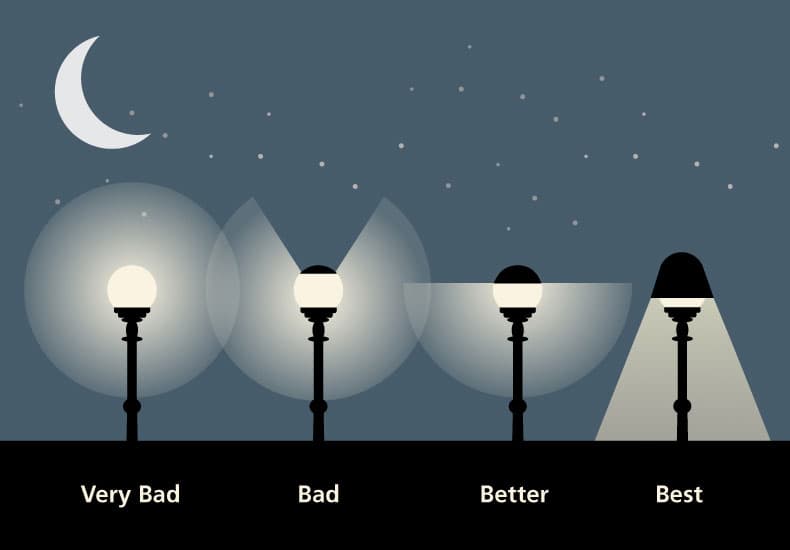
Install shielded light fixtures that direct light downward, reducing sky glow
Dim bright lights during late-night hours when foot traffic is minimal
Advocate for dark sky ordinances in your municipality
Notable Examples Already Working: The 9/11 Memorial in New York temporarily switches off its powerful tribute lights when large numbers of migratory birds begin circling during peak migration periods — allowing them to reorient and continue safely. Organizations like the Fatal Light Awareness Program (FLAP) in Toronto rescue injured birds, conduct research, and push for smarter lighting policies in cities.
Using a light pollution filter when observing the night sky also helps raise awareness by showing people just how much brightness has been added artificially — what the sky looks like without light pollution is often a revelation that motivates change.
FAQ: Light Pollution and Wildlife
Q: How does light pollution affect nocturnal animals specifically? Nocturnal animals evolved to hunt, feed, and navigate in near-total darkness. Artificial lighting disrupts these behaviors by suppressing melatonin production, altering predator-prey dynamics, and interfering with natural signals used for reproduction and communication.
Q: Why is darkness important for wildlife? Darkness isn't just the absence of light — it's an active ecological resource. It governs reproductive cycles, enables safe migration, supports insect communication, and regulates the behavior of thousands of nocturnal species. Without it, ecological balance collapses.
Q: Are sea turtles really affected by light pollution from street lights? Yes, significantly. Light pollution from street lights and beachfront development causes sea turtle hatchlings to crawl inland toward artificial brightness instead of toward the ocean. This disorientation is a leading cause of hatchling mortality on developed coastlines.
Q: What would the sky look like without light pollution? In areas free of artificial lighting, the Milky Way night sky without light pollution is vivid, with thousands of stars visible to the naked eye. Most people living in cities have never seen a truly dark sky — which also means most people underestimate how profoundly we've altered the night environment.
Conclusion: Protect the Night, Protect Wildlife
Darkness is not something to eliminate — for millions of species, it's a lifeline. From guiding sea turtle hatchlings to the ocean to helping migratory birds cross continents, the natural night sky plays a role in survival that we've only begun to fully appreciate.
Protecting wildlife doesn't mean turning off every light. It means lighting smarter — shielding fixtures, choosing warmer wavelengths, and turning off what isn't needed. As our cities expand, learning to coexist with natural rhythms becomes one of the most important conservation acts we can take.
Sometimes the most powerful thing we can do for wildlife is simply this: let the night be dark again.