What small creatures taught me about the hidden life of Punjab's farms, forests, cities, and grasslands
Amna Razzaq
June 22, 2026
You'd be likely to see the obvious things at first glance sunflowers, perhaps some crows overhead if you stopped to observe a sunflower field in Punjab, on a warm afternoon. If you'd been there longer and
had looked more carefully, though, you'll begin to notice something else: a
beetle crawling toward a mass of aphids on a stem. A myna bird following a
buffalo that is grazing, picking the insects that the buffalo's hooves dislodge.

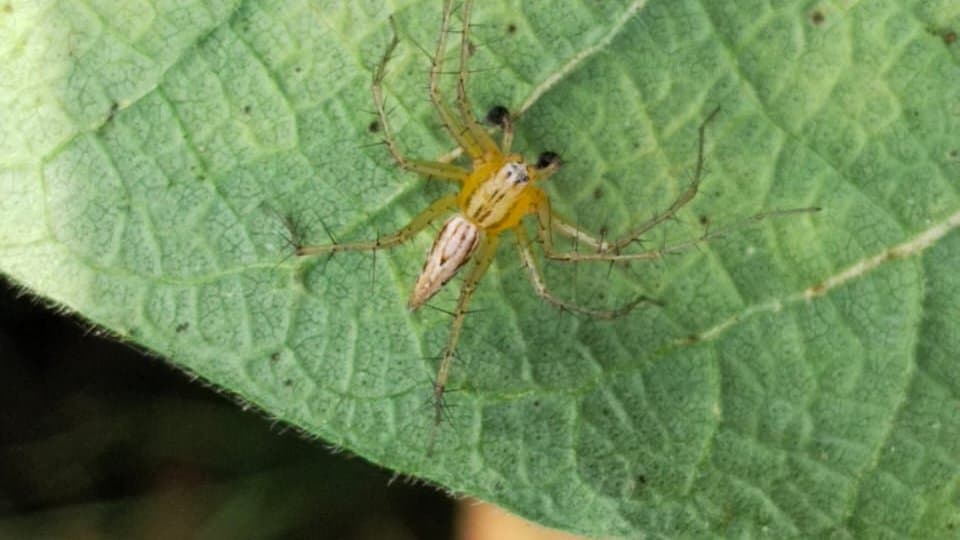
Doubtful spider, waiting and still in a web between two stalks. None of these are talking in a language that we know. In all things significant to an ecologist, however, they are "talking" to one another at all times. I've been listening to those conversations for the last 1 year. Not metaphorically, but actually, one by one across four very different landscapes in Punjab: farm, forest, city and open rangeland. When I finished, I had recorded 9,228 individual interactions between species. All of them shared information with me on how nature actually operates here, outside of the books and beyond the news of climate change and biodiversity loss that we hear so much about. So here's my way to give that mountain of information back to human the story behind the spreadsheets if you will. Why Bother Counting Bugs
Talking to Birds? Ecosystems aren't built of species: They're based on interactions among species. A forest is not an inventory
of the kind of trees, birds and insects that are found there, it is the
totality of what those organisms do to one another. Who eats whom. Who protects whom. Someone who takes advantage of
another's mess without being noticed. This web of interactions is
known to scientists as a species interaction network, and this is one of the most effective ways we have of examining an ecosystem to determine if it is healthy, fragile or slowly dying. Rather than posing the simple question, "how many species live in this farm, or in this forest, or in this city park," I asked a more interesting question: how do they all
relate to each other? Who's related to whom and how? Four Very Different Neighborhoods To sample land use in Punjab,
I selected four ecosystem types that, in combination, cover most aspects of land use in this region: agricultural fields, forest patches, urban green spaces, and open rangeland. Imagine that they are four distinct neighborhoods, quite different people live there, social codes differ,
and ways of living are different. I observed who was interacting
with whom in these neighborhoods, over the years, a ladybird beetle feeding on an aphid, a cattle egret following a buffalo, a parasitic wasp laying its eggs in another insect somewhere a process that I followed over many months of fieldwork. With thousands of observations, a picture begins to form.

The agricultural fields turned out to be the busiest
neighborhood of all home to the widest
variety of species.
These numbers did come as a bit of a shock for me. I didn't expect the forest to win, by any means but it did, and the variety of life was a huge part of that. Rather, it was agriculture
that outdid it with 347 different species recorded, whereas 320 were recorded in the forest, 268 in the city and 230 on the rangeland. In fact, a farm in Punjab, its
crops, fruit orchards, irrigation channels, herds of grazing animals and scattered trees are a surprisingly generous host. It's not simply one habitat, it's multiple habitats, joined together. Connect with some of the Regulars Numbers can be a bit
impersonal and cold, so let me introduce you to some of the species that seemed to recur in my notebook over and over again in each and every ecosystem I studied. The Common Myna, the social butterfly. I found the common myna almost
everywhere: in the fields, forests, on the roads of the city, and on open and unobstructed grassland, and it was working hard. This bird appeared in hundreds of encounters in all ecosystems, typically trailing groups of grazing animals such as cattle and buffalo, and intercepting insects disturbed by the grazing
animals. It is one of the type of relationship that ecologists refer to as ‘commensalism' one person (the myna) is clearly benefiting
from the other (the buffalo), who appears to be neither affected nor disinterested. Wherever I looked, it was by
far the most frequent type of relationship I observed. The Cattle Egret, the buffalo's shadow. A near-replica of the story of
the myna. Cows, goats, and buffaloes
were invariably accompanied by cattle egrets, who walked in step, pecking out the insects that they dislodge from their backs. So predictable that one can
assume that cattle egrets will serve as a good indicator of where livestock have recently been. Old enemies, Ladybird Beetles
and Aphids. A classic. Ladybird beetles are not far
behind the aphid cluster wherever it is on the plant stem and will be munching its way down the plant, one aphid at a time. Not only is this predation in its purest form, but it's also one of nature's finest pest control services for
free, to the farmers whose crops the aphids would often harm. An unlikely alliance: Ants and Aphids. Here is a tale of a stranger. Not all ants are predators some feed the aphids a sugary substance called honeydew, in exchange for their protection against predators, such as the ladybird beetle above. It's a symbiotic partnership where both parties are getting something out of it: a relationship which can be compared to farming, except farming by ants and livestock consisting of aphids instead. In all four ecosystems one type of relationship emerged as the preeminent one: Commensalism, that is, a more subtle relationship, in which one party benefits from the presence of another. The Farm Has More Neighbors. A more just society in the
Forest. The story becomes more interesting than you can deduce from a species count. The agricultural ecosystem was
indeed more species than there are. However, when looking at the
amount of evenness in the distribution of species, as measured by a phenomenon known as the Shannon-Wiener Diversity Index, a metric used by ecologists to quantify diversity and balance, the forest took the lead. In the farmland, a few species
were able to dominate the interaction records, mostly the crop plants themselves (such as sunflower and mustard), and a few hyper-social birds (such as the myna). The other half of the pie was far less substantial. There, on the other hand, everything was more balanced in the forest. There was no dominant species. That's what the difference is between a fun city where a handful of celebrities get the limelight, and a smaller town where everyone knows everybody. Not every time do more residents
equal a more equitable society. Who's a Local and Who's Just
Passing Through? A favorite thing about this
data was determining which species were consistent in their habitat use and which species changed from one habitat to another. Birds, and flying insects, unsurprisingly, were the great wanderers, equally at home in a wheat field, a forest clearing or a city park.

Agricultural and forest ecosystems each had around
140 species that showed up nowhere else in the study true locals, found in no other neighborhood.
The rangeland had the most bizarre story. Of those, only 61 species were locals; every other species was a visitor which also showed up elsewhere. There's a certain logic to this: A relatively low diversity of grasses and shrubs in open rangeland doesn't provide the same range of food and cover found in a farm or forest. Those species that are present, tend to be generalists and able to live almost anywhere, rather than specialists that are restricted to one type of habitat. The title of this article is a
genuine question.This article title is a real question. Easy to read all this and say: “so what?” Here's the so-what. All those 9228 interactions keep an ecosystem in place, one by one. Aphid-killing ladybird beetle is guarding a farmer's crop without his permission. The myna that follows the buffalo is part of a pest-control system that has been quietly in operation for a longer period than anyone can keep track of. The ants that work their "livestock" of aphids are a part of a relationship as ancient as agriculture. Think biodiversity protection and you will typically think of protecting a species a tiger here, a rare orchid there. For me this research
reemphasized, however, that it's the interactions between species that are just as important to consider. It is possible to
"save" a species by preserving some individuals in a sanctuary, but removing all of its former partners in life (the prey, the pollinators, the unlikely allies) is not saving its place in the ecosystem. You have simply saved the name on a list. The farms, small wooded areas, urban gardens and rangelands of Punjab are all playing different roles in this grand narrative. The farmland is the most crowded neighborhood, and has the broadest range of characters. The forest is the most
balanced forest as there is no single species which dominates the forest. In spite of its limited composition, the rangeland is the most tightly coupled community: the species have more interactions with one another than with any other community, possibly because there are fewer options to interact with. But the city usually portrayed as a place with a void to its ecology proved to be more vibrant than one might have imagined: parks and roadside greenery quietly performing more ecological functions than they are credited for. A Closing Thought I began this research with the intent of creating a thesis. It also gave me something else a different perspective of the world outside my window somewhere along the way. I cannot now look at a field
of sunflowers without wondering what it is that people are talking on the stems. I can't go by a cattle egret without its gentle, ancient arrangement with a buffalo. My wish is that the next time
you are outside, whether in a field, forest, city park or open grassland, you will take a little more time. Look closely. There is a whole society of little lives carrying on their business there, that's usually not noticed. They're already talking to each other about these things, and if we're careful, they'll continue to talk to each other long after we're gone.