The Bird That Ties Knots for a Living , and Is Running Out of Thread.
Amna Razzaq
September 1, 2026
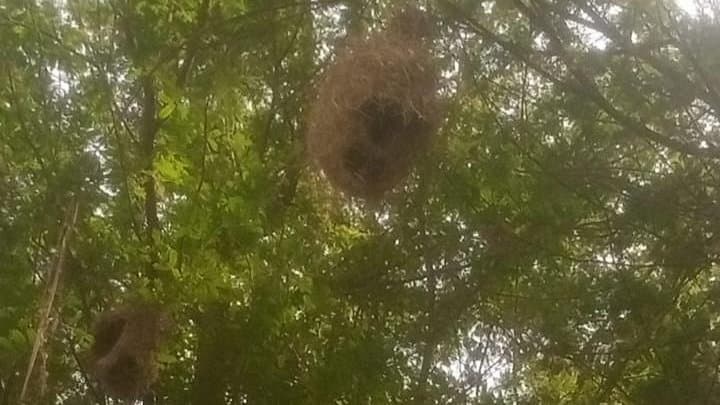
A bird exists in the paddy belts of South Asia that does something that most birds do not bother with it builds with knots. The male Baya Weaver (Ploceus philippinus) picks out long fibers from the blades of grasses, palm fronds or paddy leaves, and constructs a hanging retort-shaped nest from them really, in the manner of a sailor, in loops and hitches – from a thorny branch or palm frond hanging over water. It is one of the more amazing feats of avian engineering in the entire world and for centuries it was left to a simple but often overlooked element: a regular source of long green pliable leaves at the edge of a rice field.
It’s slipping away, and Baya Weaver’s tale is a mini-tragedy of habitat loss that isn’t always a bulldozer. It can be in the form of a more tidied field boundary at times.
A bird that requires three at the same time
Baya Weavers build their nests in colonies. Dozens of males will build on a single tree, vying for the interest of females that check out each nest, testing the weave, looking at the entrance tunnel, and in some cases, discarding a half-finished nest before the male comes along, tears it down and rebuilds. To accomplish this, a colony requires three things to be close by: a safe tree to nest in, typically thorny or palm; available open grassland or crop fields to forage for insects and grass seed; and, finally, an abundant and sustained supply of long fibrous leaves to use for construction, which is often overlooked. Traditionally, all three have been provided by paddy fields. The rice paddies are flooded which drives predators away from the nesting trees; the margins and bunds around the paddies grow the tall, flexible grass that the birds prefer for foraging; and the adjacent crops are foraging habitat. It is a neat little eco-system and Baya Weavers have made this their sole breeding strategy.
The trouble is with the margins.
It isn’t so much the paddy itself that changes as its edges. Trimmed uniform bunds are desirable for mechanised harvesting. Weed control of field margins is carried out to prevent weed competition and the removal of tall grasses is precisely what the birds remove for fibre. When small land holdings are merged into larger, more intensively managed blocks, the scruffy, ungroomed in-between spaces are eliminated—the hedgerows, the odd corner, the strips of grass to which no one was sure of ownership—spaces that were reservoirs for construction material. The urban expansion at the urban fringe of the rural land takes over the paddy land outright, which is the first one to be taken up, as flat, already cleared and near the existing road.
All of these pressures are not targeted at the Baya Weaver. There is no attempt to take away its nest material, it’s just the by-product of decisions taken about crop yield, land and field efficiency values. This is why it’s an actual conservation story instead of just a villain story. There is no person you can blame, and no one who can make the only, single, and final change.
The lack of a material is more significant than the lack of a tree.
Bird conservation naturally turns to the nesting tree as the entity to be conserved — plant trees and save old trees, that’s it. However, even in the absence of disturbance of the tree, Baya Weaver colonies may fail if there is insufficient fiber in the vicinity of the tree. Males have been seen deserting unfinished nests and venturing further from the nest to collect nesting material, using up energy and time during an already limited breeding season. Longer foraging bouts for fibre also implies greater exposure to predators and disturbance to the colony. The lack of building material doesn’t only slow down the birds, it can also alter the economics of the breeding season, moving colonies to smaller size, later starts or even failure in a particular year in a landscape that still looks to the human eye quite fine.
The easy-to-miss segment of this equation is a structurally sound, but functionally absent habitat for a species that requires a particular resource. The paddy margin is not a scenic resource. It is not directly apparent in most land-use surveys, since “loss of unmown grass strips” is not as readily identifiable as “loss of forest.
A small margin as a conservation lever
The positive side of this tale is that it takes very little to remedy. Baya Weavers are not connoisseurs of pristine wild lands. What they require is a landscape where a small portion of their edges remain uncut—where a corner of grass is left outside to nest, where a hedgerow doesn’t have to be cut down every time you use herbicide. These are the interventions that cost little and may in some situations be entirely compatible with farming – indeed, in some, it may be possible to practise them in harmony with the weaver’s breeding schedule.
That is a real conservation request that is not along the lines of “save this forest” or “don’t build this development. It’s more like asking a landscape to allow some “untidiness” in certain spots at certain times of the year – an ask that’s cheap, reversible, and won’t force a land out of production. Whether or not it does depends more on the ecology, and more importantly, whether or not agricultural policy, extension programmes and the farmers themselves hear the birds of the paddy edge, running out of thread as they sails knots into their nests.
At the core of the Baya Weaver’s conundrum is not the bird but the problem itself. It’s a reminder that habitat is not only a place, it’s the particular materials the species requires from that place — which can disappear long before the place does.