Reptilians and Humans: Where the Theory Comes From, and What Science Actually Says
Amna Razzaq
October 17, 2026
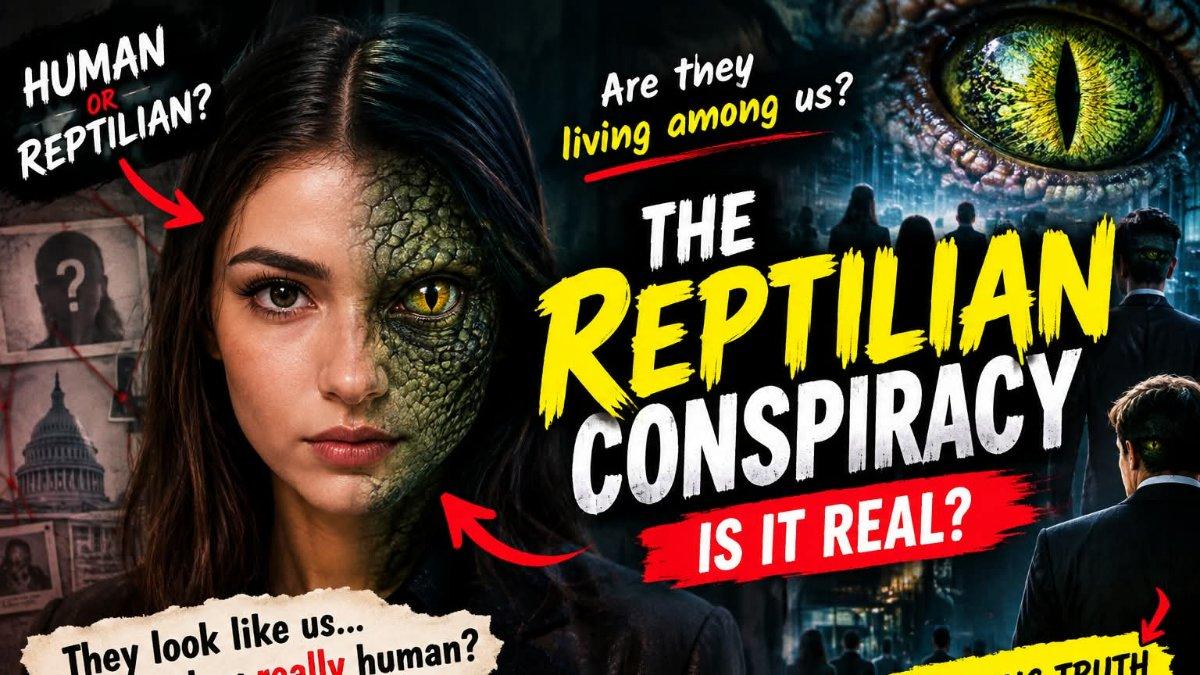
If you've spent any time online, you've probably seen it: a grainy video of a politician or celebrity "glitching," a caption claiming their eyes look like a lizard's, and a comment section insisting that some people in power aren't fully human. This is the reptilian conspiracy theory, and it's one of the most widespread modern myths out there.
So where does it come from? Is there any real relationship between reptiles and humans? Let's separate the story people tell from what the evidence shows.
What Is the Reptilian Theory?
The core claim is that shape-shifting, lizard-like beings from another world (or dimension) secretly live among us, take human form, and control governments, banks, and the media. Followers often point to famous people and say they "look reptilian."
There is no scientific evidence that any such beings exist. No fossil, DNA sample, medical record, or verified footage has ever supported the idea. But the story is worth understanding, because its history is surprisingly well documented.
Where Did the Theory Come From?
The modern version was popularised by David Icke, a former professional footballer and BBC sports presenter. His 1999 book The Biggest Secret is widely seen as the defining text of the modern reptilian narrative (Fritze, Hope and Fear; IBTimes UK, 2026).
But Icke didn't invent it from nothing. Researchers describe it as a patchwork of older ideas:
Zecharia Sitchin's "ancient astronaut" writing. Religious studies scholar David G. Robertson notes that Icke's reptilian idea draws on Sitchin's 1976 book The 12th Planet, combined with material from the South African healer Credo Mutwa.
Earlier occult and pulp fiction. Scholars such as Michael Barkun point to a chain running from Robert E. Howard's 1929 story "The Shadow Kingdom" through 20th-century occult writings to Icke. Historian Edward Guimont has also traced earlier sources behind Icke's version.
UFO and Cold War culture. Researchers argue the theory grew out of alien-conspiracy culture that began after World War II, when secrecy, government cover-ups, and mass media made extraterrestrial stories easy to spread.
Colonial-era myths. Some historians argue the story also recycles older, racialised legends about "ancient hidden civilisations" in Africa and elsewhere.
Academics generally describe it as a syncretic idea: a blend of many older stories repackaged into one global narrative.
Why Critics Say It's Not Harmless
Scholars and watchdog groups have repeatedly pointed out that the "reptilian elite" story overlaps with much older hateful conspiracy ideas. Daniel Allington and David Toube argued in 2018 that Icke's claims about blood-drinking, Satan-worshipping elites echoed medieval antisemitic myths, and organisations such as the ADL and Hope Not Hate have documented antisemitic tropes in his work. Icke has denied being antisemitic, and some scholars note that he names many non-Jewish figures as "reptilian" too. Still, the concern is that the "secret ruling bloodline" format makes it easy for real-world prejudice to ride along.
How widespread is belief? A 2013 Public Policy Polling survey reported that about 4% of American registered voters said they believed in Icke's ideas. That is a small share, but it's a lot of people.
So Are Humans and Reptiles Actually Related?
Here's where real science gets interesting, because the honest answer is yes, but very distantly, and not in the way the conspiracy imagines.
Humans (mammals) and reptiles (including lizards, snakes, turtles, crocodiles) and birds all belong to a large group called amniotes. We share a common ancestor that lived around 300 million years ago. After that, the lineage split in two: one branch eventually led to mammals, the other to reptiles and birds. These two branches have been evolving separately ever since.
In other words, we're very distant cousins, not parent and child, and certainly not a hidden species wearing a human disguise. Go back even further and every vertebrate, including fish, shares an ancestor with us.
What About the "Reptilian Brain"?
You may have heard that humans have a "lizard brain" buried inside our heads. This idea, called the triune brain, was proposed by neuroscientist Paul MacLean in the 1960s. He suggested the brain evolved in three layers: a "reptilian" core for instinct, a mammalian layer for emotion, and a human layer (the neocortex) for reason.
It's a tidy story, and it's still widely repeated in self-help and business books. But neuroscientists have largely abandoned it:
Mammals did not evolve from reptiles. Both groups descended from a shared ancestor, so there's no "reptile stage" sitting inside us.
A 2018 study of bearded dragon brains found that mammals and reptiles share a set of ancient neuron types inherited from that common ancestor, but these are spread throughout the brain rather than locked into a single "primitive" region.
Structures like the basal ganglia, which MacLean called "reptilian," exist in all vertebrates and likely date back more than 500 million years.
So you don't have a lizard in your head. You have a human brain that shares some very old, very general building blocks with many other animals.
Why Do People Think Some Humans "Look Reptilian"?
If there's no evidence, why does the theory feel convincing to some people? A few well-understood reasons:
Pareidolia. Our brains are wired to find patterns, especially faces. We can "see" odd features in any photo or video.
Compression and filters. Video glitches, lighting, and filters can make anyone's eyes or skin look strange for a frame or two.
A simple story for a complicated world. Conspiracy theories give people a clear villain to explain frustrating events. Some researchers argue the reptilian story also became a way to explain why a hoped-for "new age" never arrived.
Echo chambers. Online platforms let niche beliefs find each other and spread far beyond where they started.
References
David Icke — overview of his reptilian claims, influences (Sitchin, Mutwa), and antisemitism debate. Wikipedia. https://en.wikipedia.org/wiki/David_Icke
Reptilian conspiracy theory — origins, Barkun and Guimont's analysis, 2013 PPP poll. Wikipedia. https://en.wikipedia.org/wiki/Reptilian_conspiracy_theory
"Who Started the 'Reptilian Elite' Theory?" IBTimes UK. https://www.ibtimes.co.uk/susan-dell-white-house-reptilian-conspiracy-theory-1825008
Fritze, R. Hope and Fear: Modern Myths, Conspiracy Theories and Pseudo History. Reaktion Books.
Robertson, D. G. UFOs, Conspiracy Theories and the New Age. Bloomsbury.
Allington, D. & Toube, D. (2018) on Icke and antisemitism, as summarised in the Wikipedia article on David Icke (ref. 1).
"What's The Deal with Conspiracy Theories?" SUNY Cortland Digital Commons. https://digitalcommons.cortland.edu/cgi/viewcontent.cgi?article=1011&context=programs
"You Don't Actually Have A 'Lizard Brain', Evolutionary Study Reveals." ScienceAlert. https://www.sciencealert.com/you-dont-actually-have-a-lizard-brain-evolutionary-study-reveals
"The 'lizard brain' lie: How neuroscience demolished the greatest mind myth." BBC Science Focus. https://www.sciencefocus.com/the-human-body/the-lizard-brain-lie
Triune brain — history and criticism of MacLean's model. Wikipedia. https://en.wikipedia.org/wiki/Triune_brain
"Mammals, birds and reptiles evolved with signature proportions of numbers of neurons across their brain structures." bioRxiv (preprint), on the shared amniote ancestor ~300 million years ago. https://www.biorxiv.org/content/10.1101/2022.06.20.496835.full.pdf
MacLean, P. D. (1990). The Triune Brain in Evolution: Role in Paleocerebral Functions. Plenum Press.