Do Koalas Have Fingerprints? and They Look Just Like Ours
Amna Razzaq
July 15, 2026
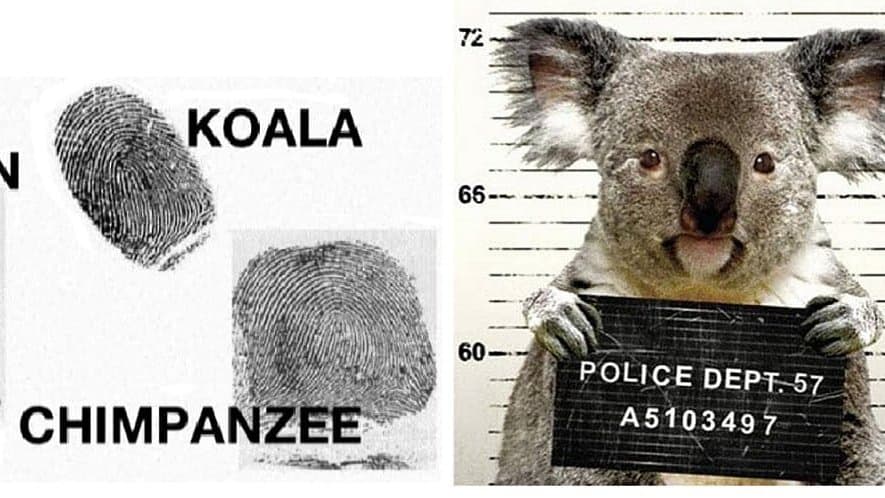
Koalas look like they were designed purely for napping round ears, sleepy eyes, and a talent for sleeping up to 20 hours a day. But hiding on the pads of their paws is one of the strangest facts in the animal kingdom: koalas have fingerprints that are almost indistinguishable from human fingerprints. Not similar in a vague, "oh that's kind of like ours" way — actually, genuinely close enough to fool an expert.
This isn't an internet myth or a cute exaggeration. It's a real discovery, made by real scientists, and it has been confirmed again and again since.
Wait, Really? Since When Do Koalas Have Fingerprints?
In the mid-1990s, biological anthropologist and forensic scientist Maciej Henneberg was examining koalas at the University of Adelaide when he noticed something odd on their paws: tiny looping, whirling ridges the same kind of pattern you'd find on a human fingertip. Curious, his team studied the prints under a microscope and compared them directly to human fingerprints.
The ridges matched so closely in shape, spacing, and complexity that Henneberg later said not even careful microscopic analysis could reliably tell a koala's print apart from a person's. He published the discovery in the journal Natural Science, and it's held up under scrutiny ever since.

The Part That Really Confuses Scientists
Here's what makes this genuinely strange rather than just a fun trivia fact: koalas aren't related to us in any way that would explain it. Primates humans, chimps, gorillas, orangutans are the only other animals known to have true fingerprints. Koalas are marsupials. Their evolutionary line split from the ancestors of primates roughly 70 million years ago, long before fingerprints (as far as we know) even existed.
Even koalas' closest living relatives — kangaroos, wombats, and other marsupials don't have fingerprints at all. Somehow, koalas evolved this trait completely on their own, with no shared ancestor to explain where it came from.
So Why Do They Have Them?
Scientists believe it comes down to a shared problem needing a shared solution — a process called convergent evolution, where unrelated species independently evolve similar features because they face similar challenges. Koalas spend nearly their entire lives in trees, gripping smooth branches and delicately stripping individual eucalyptus leaves with their fingers.
● Better grip: Ridged fingertips increase friction, which helps koalas cling to branches and climb without slipping.
● Finer control: The same ridges that help humans pick up small objects likely help koalas handle individual leaves.
● Moisture balance: Fingerprint ridges channel sweat in a way that keeps skin from being too dry or too slick — useful for a life spent gripping bark and branches.
● Sharper touch: Ridges are thought to amplify tiny vibrations against nerve endings, giving a more detailed sense of texture.
Could a Koala's Print Really Be Mistaken for a Human's?
In theory, yes — and that's not just speculation. Henneberg himself raised the concern that a koala's print left at a crime scene could genuinely confuse investigators if they weren't specifically looking for it. It hasn't caused a real forensic mix-up, but Australian researchers have noted it as a legitimate, if extremely unlikely, complication for fingerprint evidence in rural areas.
Even more unexpectedly, koalas aren't entirely alone in this quirk: chimpanzees and orangutans also have humanlike fingerprints, and in 1975 police in one case actually fingerprinted several apes to rule them out as suspects. But koalas remain the only non-primate ever found to share this trait.
The Takeaway
Koalas already seemed like nature's most laid-back animal it turns out they're also one of its strangest evolutionary puzzles. Two species separated by 70 million years of evolution, with no shared fingerprint ancestor between them, somehow arrived at nearly the same fingertip design. It's a reminder that evolution doesn't always take a straight path sometimes it finds the same clever answer twice.
So next time someone tells you koalas are "just" sleepy tree-huggers, you can tell them they're literally leaving human-like fingerprints on every branch they touch.