Crayfish Plague: The Molecular War Beneath Europe’s Fresh-waters
Admin
March 12, 2026

White-clawed crayfish (Austropotamobius pallipes) Image by Chucholl, Ch.
Europe’s rivers are losing one of their most important freshwater species. A deadly disease known as crayfish plague is silently wiping out populations of the native white-clawed crayfish.
Walk along a quiet European stream and the water may appear calm and uneventful. Beneath the surface, however, an entire world exists among the stones, roots, and submerged plants. Hidden in these small underwater shelters lives a modest but fascinating animal: the white-clawed crayfish (Austropotamobius pallipes).
For centuries this freshwater crustacean has been part of the natural life of rivers and streams across parts of Europe. Although it rarely attracts the attention given to fish or birds, its presence quietly supports the balance of aquatic ecosystems. By feeding on organic debris, algae, and small invertebrates, crayfish help recycle nutrients and maintain ecological stability in freshwater habitats.
Yet today this species is facing a serious and often invisible threat. Across many European regions, populations of the white-clawed crayfish have declined dramatically. In places where they were once common, they have become rare or disappeared altogether. The biggest threat to Europe’s native crayfish is something most people will never see.
It is a microscopic organism called Aphanomyces astaci, a water borne pathogen responsible for a disease known as crayfish plague. This microscopic organism may be invisible to the naked eye, but its impact on crayfish populations has been profound.
Meet the White-Clawed Crayfish

White-clawed crayfish (Austropotamobius pallipes) inhabiting rocky freshwater habitats..
Image credit: Pmau
The white -clawed crayfish is one of the few crayfish species that naturally evolved in Europe. It thrives in cool, well-oxygenated freshwater environments. It prefers streams and rivers where stones and submerged structures provide safe hiding places. During the day these animals typically remain concealed beneath rocks or within crevices, emerging mostly at night to search for food.
Their diet is surprisingly diverse. Crayfish consume decaying plant material, aquatic insects, small worms, and other organic matter. In doing so, they act as both scavengers and predators, helping to keep freshwater ecosystems functioning smoothly.
Because they are sensitive to pollution and habitat disturbance, crayfish populations are often considered indicators of good water quality. When these animals disappear from a river, it can signal deeper environmental changes occurring within the ecosystem.
For this reason, the decline of the white-clawed crayfish has raised serious concerns among scientists and conservationists. Protecting this species is not simply about preserving a single animal; it is about maintaining the health of entire freshwater environments.
A Disease That Changed the Fate of European Crayfish

Microscopic view of the pathogen Aphanomyces astaci, responsible for crayfish plague.
Image credit: Bram Koese
The story of crayfish plague is closely linked to the movement of species across continents. The pathogen responsible for the disease, Aphanomyces astaci, belongs to a group of aquatic microorganisms known as water moulds. These organisms thrive in moist environments and reproduce by producing tiny swimming spores.
While the pathogen is deadly to many European crayfish species, it does not affect all crayfish in the same way. Some North American crayfish species carry the pathogen without suffering serious illness. When these species were introduced into European waters during the past century, they unintentionally brought the pathogen with them.
Once established in a new environment, the pathogen spread through rivers, lakes, and connected waterways. Native crayfish populations that had never encountered this organism before had little natural resistance, making them extremely vulnerable to infection.
In many regions, this disease rapidly transformed the landscape of freshwater biodiversity.
How the Infection Begins
Although the pathogen itself is microscopic, its life cycle is remarkably efficient. The organism produces spores that can swim through water for short distances. These spores search for a suitable host and attach themselves when they encounter a crayfish.
Once attached to the outer shell, the pathogen begins to grow and penetrate the protective surface of the animal. From there it spreads through tissues within the body. The infection gradually disrupts normal biological processes, weakening the crayfish and interfering with its movement and behavior.
Infected crayfish often behave in unusual ways. They may become disoriented, move slowly, or emerge from hiding during daylight hours. As the disease progresses, the nervous system can be affected, leading to loss of coordination.
Eventually the infection becomes fatal.
What makes crayfish plague particularly destructive is how quickly it can spread through a population. In some documented outbreaks, entire groups of crayfish within a river have disappeared in a matter of weeks.
Why Some Crayfish Survive While Others Do Not
One of the most intriguing aspects of crayfish plague is the difference in resistance between species. Certain North American crayfish species can carry the pathogen with little visible harm. These species act as reservoirs of the disease, allowing the pathogen to remain present in aquatic environments.
In contrast, many European species—including the white-clawed crayfish—are highly sensitive to infection. Their immune defenses often struggle to control the pathogen once it enters the body.
This difference in susceptibility explains why the disease has had such a severe impact on native crayfish populations. When resistant species coexist with vulnerable ones in the same ecosystem, the pathogen can spread continuously while the native species decline

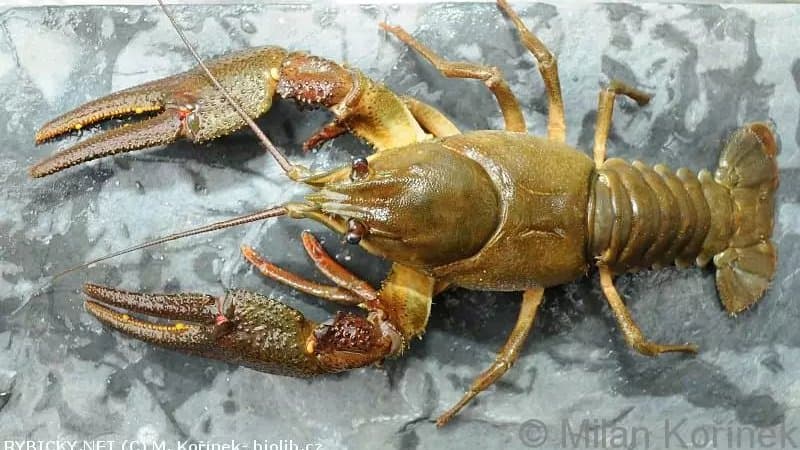
Invasive crayfish species(signal crayfish) can carry the pathogen without experiencing severe disease.
Image credit: Astacoides
Ecological Consequences of Crayfish Loss
The disappearance of crayfish from freshwater ecosystems can have far-reaching consequences. Because crayfish play such an important role in nutrient cycling and food-web dynamics, their loss can alter the balance of entire aquatic communities.
Without crayfish feeding on plant debris and organic material, decomposition processes in rivers may change. This can influence nutrient availability for other organisms.
Crayfish are also an important food source for several animals, including fish, birds, and mammals. Their disappearance can therefore affect predators that depend on them as part of their diet.
In some ecosystems, the loss of native crayfish has also been associated with increases in certain invertebrate populations that would normally be controlled by crayfish predation.
These changes demonstrate how the decline of a single species can influence the broader functioning of an ecosystem.
Protecting Native Crayfish: Conservation Efforts
Despite the challenges posed by crayfish plague, scientists and conservation groups across Europe are actively working to protect remaining populations of native crayfish.
One of the most important strategies involves monitoring rivers and lakes for the presence of the pathogen. Advances in environmental DNA technology now allow researchers to detect traces of the pathogen in water samples before visible disease outbreaks occur.This technique provides an early warning system that can help conservationists respond more quickly to potential outbreaks.
Another important conservation approach involves protecting habitats where native crayfish still survive. Maintaining clean water, stable riverbanks, and natural vegetation along waterways can improve the chances of long-term survival for these populationsIn some cases, conservation programs have also established protected areas where invasive crayfish species are carefully controlled
.Public awareness also plays an important role in preventing the spread of the disease.
Preventing the spread of crayfish plague is now a major priority for conservation groups. Even small actions can make a difference. Equipment used in rivers—such as fishing gear, boots, or sampling tools—should be properly cleaned and dried before being used in another water body
These actions may seem small, but collectively they can help slow the spread of crayfish plague and protect remaining populations.
Looking Ahead
Although the challenges facing native crayfish are serious, the story is not entirely one of decline.
In recent years, growing scientific attention has helped improve our understanding of crayfish plague and its ecological impacts. Researchers continue to develop better monitoring techniques and conservation strategies aimed at protecting native species.
Protecting the white-clawed crayfish ultimately means protecting the rivers and streams where it lives. Healthy freshwater ecosystems support countless forms of life, from insects and fish to birds and mammals.
Sometimes the most important creatures in these ecosystems are also the least visible.
Beneath the surface of a quiet stream, the white-clawed crayfish continues its quiet work—feeding, hiding, and maintaining the delicate balance of freshwater life. Ensuring that this small but important species survives for future generations will require continued research, conservation, and public awareness.
But with careful management and sustained effort, there is still hope that Europe’s native crayfish will remain part of its rivers for many years to come.