Are We Actually Saving 30% of the Planet? The Truth Behind the 30x30 Numbers
Amna Razzaq
October 21, 2026
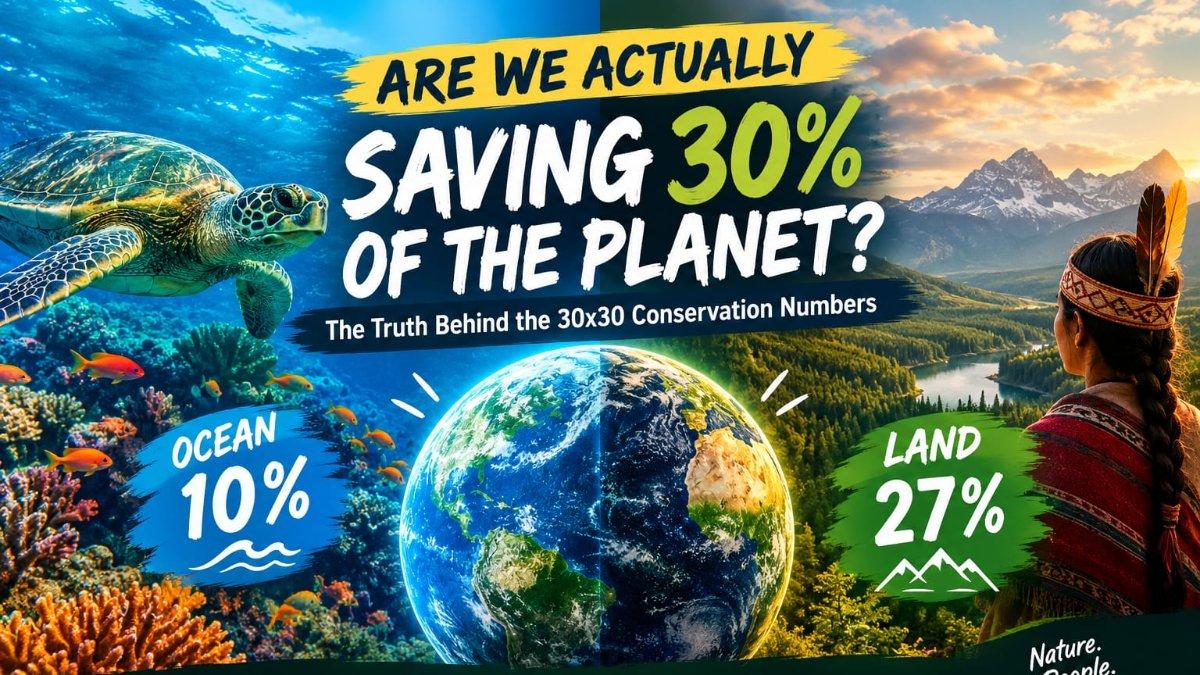
For decades, conservation looked pretty much the same everywhere. You drew a line on a map, built a fence, called it a national park, and hoped for the best. But as the UN Biodiversity Conference (COP17) gets underway, something quieter and more interesting is happening. Global ocean protection has reached 10 percent, and land coverage is climbing toward 27 percent. Not because governments suddenly bought up huge stretches of wilderness, but because we are finally counting the people who have been protecting it all along.
Let's look at what these numbers really mean, and what they hide.
What is 30x30, anyway?
In 2022, nearly every country signed the Kunming Montreal Global Biodiversity Framework. The headline promise was simple: protect 30 percent of the world's land and sea by 2030. That's where the name "30x30" comes from.
It's a big goal, and progress has been uneven. The latest figures show we are further along than many people expected, though the story behind them is more complicated than a simple victory lap.
The ocean hits 10 percent
Let's start with the blue part of the map. Formal marine protected areas and conserved zones now cover about 10 percent of the global ocean. That's a third of the way to the 2030 target, and it deserves some credit. Healthy marine protected areas help coral reefs recover, give fish populations room to rebuild, and take pressure off overfished waters.
But here is the catch. Marine scientists point out that less than 3.5 percent of the ocean is highly or fully protected from things like industrial fishing and deep sea mining. A protected area that still allows trawlers to drag nets through it isn't doing much protecting. Conservationists call these "paper parks": places that look great on a map but see little enforcement in real life.
The high seas, the waters that belong to no single country, are the biggest blind spot. Only about 1.7 percent of them are protected. Closing that gap depends heavily on countries ratifying the Global Ocean Treaty quickly, and treaties tend to move slowly.
So yes, 10 percent is worth celebrating. Just not too loudly.
The land surge, and the power of a clunky acronym
On land, the story is even more interesting. Traditional protected areas like national parks cover roughly 17 to 18 percent of the world's land. But when you include something called OECMs, the figure jumps to nearly 27 percent, according to recent research published in Nature.
OECM stands for Other Effective Area Based Conservation Measures. It's a mouthful, so here is the plain English version. A national park exists for one main reason: to protect nature. An OECM is a piece of land that is managed for some other purpose, like protecting a watershed, honoring sacred cultural grounds, or harvesting resources sustainably, but the way it's managed ends up protecting biodiversity over the long term.
Think of it as an accidental nature reserve. Nobody set out to build a wildlife sanctuary, yet the land is looked after so well that wildlife thrives anyway.
Why Indigenous communities are at the center of this
Here is the part that really changes the picture. Indigenous peoples and local communities manage or hold tenure over at least a quarter of the world's land. Those territories contain around 80 percent of the planet's remaining biodiversity. That's not a coincidence.
For generations, these lands were invisible on official conservation maps. They were protected in practice, but not on paper, so they never counted toward any national or international target.
That is starting to change. By formally recognizing Indigenous Protected and Conserved Areas as OECMs, governments can update the map to match reality, and they can do it without taking control away from the people who live there. Countries like Canada have been backing this approach by funding Indigenous Guardians programs, where communities monitor and care for their own territories.
Conservation versus human rights
This matters because conservation has a painful history. The old "fortress" model of protecting nature often meant pushing people off their land. Communities that had lived sustainably in a place for centuries were suddenly treated as trespassers.
The OECM approach flips that script. Instead of removing people to protect nature, it protects nature by securing the land rights of the people already caring for it. That makes it one of the rare ideas in conservation that is good for both ecosystems and human rights.
It isn't perfect, of course. Recognition on a map is not the same as legal protection, and communities still need real support to defend their territories from outside pressure.
Quality matters more than the percentage
Maybe the biggest lesson of the 30x30 race is that the percentage alone doesn't tell us much. Thirty percent of the planet on paper means nothing if the protection is weak.
That's why the IUCN recently launched a new Global Standard for protected and conserved areas. Its aim is to measure how well these places actually perform, so the conversation shifts from "how much land is covered" to "how healthy is the nature inside it."
Money is the other missing piece. Estimates suggest around 700 billion dollars a year is still needed worldwide to tackle the biodiversity crisis by 2030. Getting areas onto the map is step one. Paying for the communities and rangers who look after them is step two, and it's the step most likely to be forgotten.
So where does that leave us?
We are probably closer to 30x30 than the headlines suggest, but the finish line is more complicated than it looks. The real test isn't whether we hit a number by 2030. It's whether the places we count are truly protected, and whether the people who protect them are respected and supported.
What do you think matters more: reaching the 30 percent target on time, or making sure every protected area is the real thing? Share your thoughts in the comments.