Are Birds Mammals? The Clear Answer (With Key Differences Explained)
AIMAN
September 2, 2026
Are Birds Mammals? Here's the Science-Backed Answer
Watch a sparrow hop across your yard, or a goose honk its way south for the winter, and it's easy to see why the question comes up: are birds mammals? It seems like a simple thing to Google, but the answer says a lot about how scientists actually sort the animal kingdom — and why so many of us get it wrong in casual conversation.
Here's the short version: no, they aren't. Birds sit in their own category entirely, separate from cats, dogs, whales, and humans. But "no" isn't a very satisfying answer on its own, so let's dig into why that's the case, what actually defines each group, and why a handful of confusing creatures — bats, penguins, even the platypus — keep tripping people up.
The Quick Answer
Every bird species on Earth, all roughly ten thousand of them, belongs to a class called Aves. Every mammal, from mice to elephants, belongs to a completely different class called Mammalia. These are two separate branches of the animal family tree. One did not evolve from the other in modern times, and neither group contains a single member of the other.
If you flip the question around and ask whether mammals are birds, you get the same answer, just mirrored: no. Neither group is a subcategory of the other. They're parallel lineages that happen to share a few traits — most notably, both keep a constant internal body temperature — but that overlap isn't enough to lump them together.
What Actually Makes Something a Mammal
Biologists don't classify animals by vibes or by how cute they are. There's a specific checklist, and an animal generally needs to tick most or all of these boxes:
It nurses its young with milk produced by mammary glands
It's covered in fur or hair somewhere on its body, even if that coat is thin or patchy
It gives birth to live offspring in the overwhelming majority of cases (the platypus and a couple of its relatives are famous exceptions — they lay eggs but still count, because of everything else about their biology)
It has a four-chambered heart and regulates its own body heat
Its teeth are usually specialized for different jobs — biting, tearing, grinding
Run through that list with any feathered creature in mind, and none of it holds up. No sparrow produces milk. No eagle has fur. No robin gives birth to a live chick. So even asking the question species by species, the answer stays consistent: not a single one qualifies.
What Actually Makes Something a Bird
Flip to the other side of the family tree, and the defining traits look completely different:
Feathers — nothing else in the animal kingdom has them, making this the single clearest identifier
A beak instead of teeth, in nearly every living species
Eggs, always. Every known species reproduces this way
Hollow, lightweight bones, built originally for flight, even in species that never leave the ground
A four-chambered heart and warm blood, just like their furry counterparts
That last point is the real source of confusion. Most of us were taught somewhere along the way that warm-blooded equals mammal, and that shortcut just isn't accurate. Regulating your own temperature is a survival strategy, not a taxonomic label, and it evolved separately in these two very different lineages.
Side-by-Side Comparison
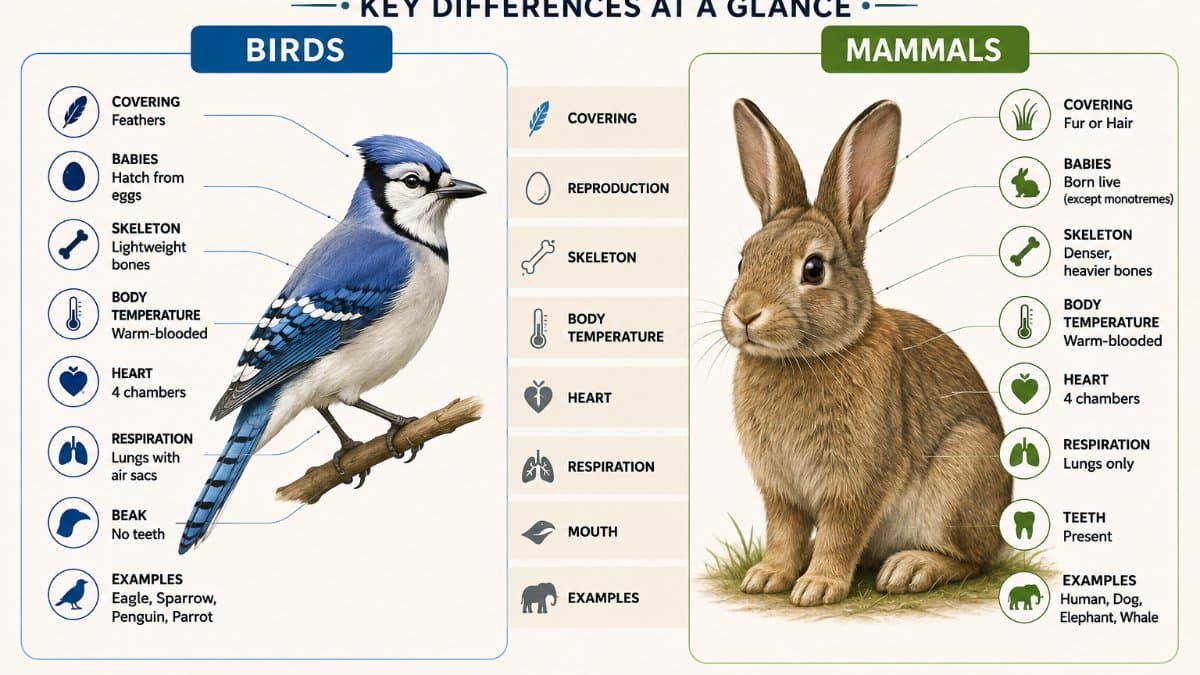
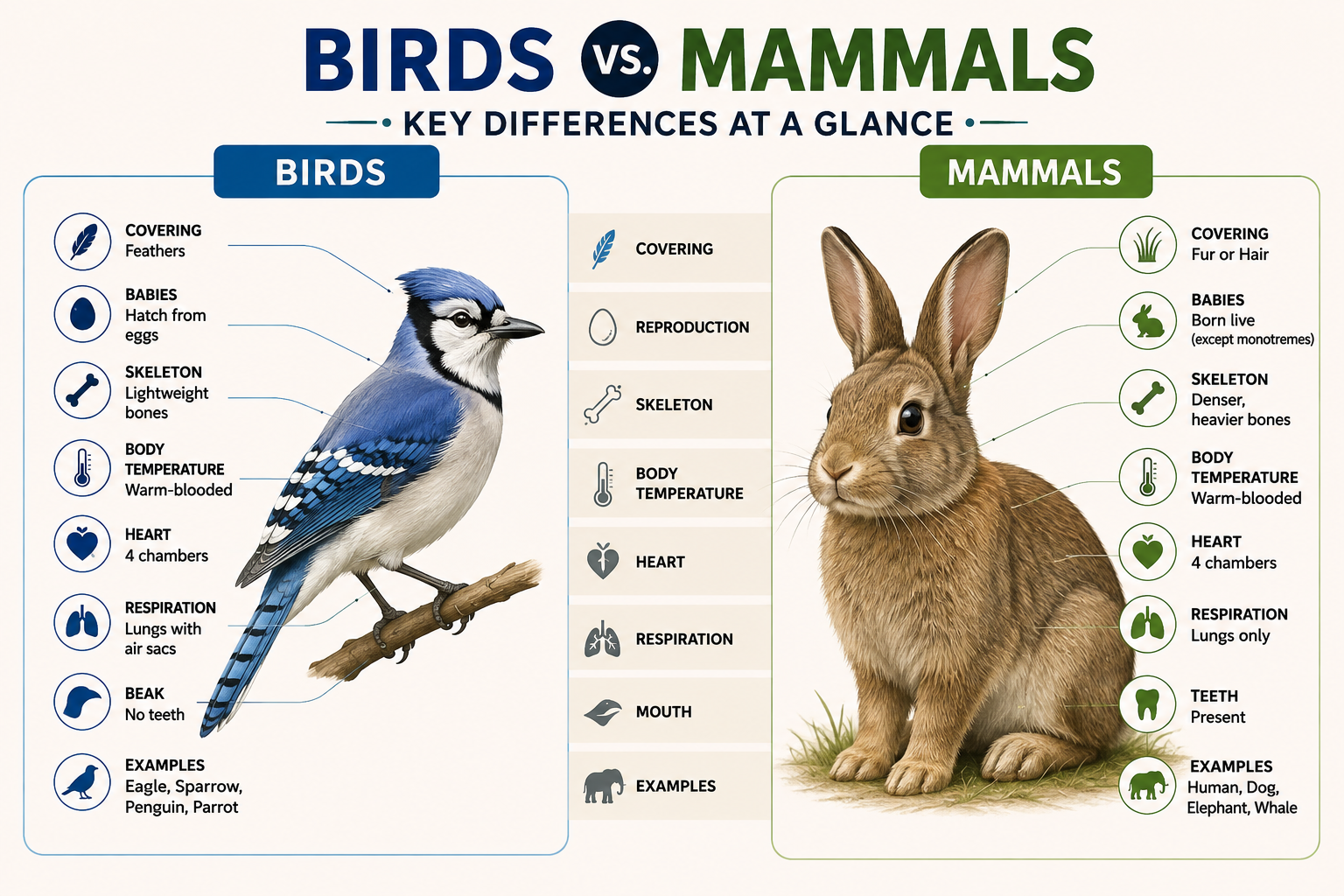
TraitFeathered AnimalsFurred AnimalsBody coveringFeathersFur or hairHow they reproduceLay eggsMostly live birthFeeding offspringRegurgitated food or foragingMilkMouthBeakTeeth (mostly)SkeletonHollow, light bonesDenser, solid bonesBody temperatureSelf-regulatedSelf-regulated
Laid out like this, the split is obvious. The two groups agree on exactly one thing — staying warm internally — and disagree on nearly everything else.
So Where Do Reptiles Fit In?
This is where things get genuinely interesting, and it's a question people ask almost as often as the original one: are these feathered animals closer to reptiles, or to the fur-and-milk crowd? The honest answer is reptiles, by a wide margin.
Modern paleontology places today's feathered species within a lineage of theropod dinosaurs — meaning their ancestry runs straight through the reptile branch of the tree of life, not anywhere near the mammal branch. That's part of why they still lay eggs, still have scaled legs under those feathers, and share so much skeletal structure with their prehistoric relatives. They technically have their own modern classification now, separate from reptiles, but genealogically speaking, that's their family.
The Real Reason for the Confusion
If you ask most people why they hesitate on this question, the answer usually comes down to one thing: temperature regulation. It's such a commonly cited "mammal trait" in school textbooks that people assume anything warm-blooded must belong in that category. But endothermy — the scientific term for regulating your own internal heat — showed up twice in evolutionary history, independently, in two unrelated groups. It's a case of convergent evolution, not shared ancestry. Sharks and dolphins both swim well and look vaguely similar, but nobody thinks they're related. This is the same idea.
What About Bats?
Bats are a genuinely tricky case, and honestly, a fair one to be confused about. They fly. They come out at dusk. From a distance, silhouetted against a darkening sky, they look almost identical to swallows or swifts doing the same thing.
But bats check every box on the fur-and-milk checklist. They have fur. They nurse their pups. They give live birth. They have teeth, not a beak. Flight is simply a trait that evolved on its own in this lineage, completely independent of anything happening in the sky above them from other flying creatures. It's proof that flying and belonging to a particular class are two unrelated things.
What About Penguins?
Penguins run the opposite problem. They can't fly, they spend most of their lives in the water, and they waddle around looking almost more like little seals than anything with wings. It's a fair mix-up.
Even so, penguins have feathers — densely packed for insulation against freezing water, but feathers all the same. They lay eggs, famously balanced on their feet through brutal Antarctic winters. They have beaks. Every defining trait lines up with their feathered relatives, not their furry ones. The inability to fly doesn't change anything; ostriches, emus, and kiwis can't fly either, and nobody questions their classification.
Are There Any Exceptions At All?
Given how many odd creatures exist in nature, it's a fair question to ask whether any species slips through the cracks. It doesn't happen here. Out of every known species with feathers, across every continent and every size range from hummingbird to ostrich, not one has ever been reclassified. If you're wondering which specific ones might qualify, the honest answer is none — zero, across roughly ten thousand documented species. The traits that define this group (feathers, eggs, beaks, hollow bones) and the traits that define the other group (fur, milk, mostly live birth) simply never overlap in a single animal.
Frequently Asked Questions
Is it possible for any of them to be mammals? No. Every single species with feathers belongs to its own distinct class. There are no exceptions.
Why do people sometimes think mammals might be birds, or the other way around? Usually because both groups share warm-bloodedness, which many people mistakenly learned as a defining trait rather than a coincidence of evolution.
Are bats mammals or something else? Bats are firmly in the fur-and-milk category. They nurse their young, give live birth, and have fur — none of which line up with feathered animals.
Are penguins actually birds, given that they can't fly? Yes. Flightlessness doesn't affect classification. Penguins have feathers, lay eggs, and have beaks, which is all that matters.
Does the platypus complicate any of this? Not really, though it's a fun tangent. The platypus lays eggs, which sounds bird-like, but it also has fur and produces milk, which are unmistakably traits from the other side. It's classified where it belongs, egg-laying and all.
Why This Classification Actually Matters
It might seem like a small thing — a label in a textbook, nothing more. But how scientists sort living things affects a lot more than trivia night. Conservation groups decide how to protect endangered species based partly on which class they belong to, since different classes tend to face different threats and require different habitats. Veterinarians and wildlife rehabilitators rely on classification to know how to treat an injured animal; you'd never feed formula meant for a fur-covered orphan to a chick that needs regurgitated insects instead. Even something as simple as a zoo enclosure gets designed around these categories, because animals from different classes have wildly different needs for temperature, humidity, nesting materials, and diet.
There's also a deeper reason this matters: classification tells a story about history. When researchers group living things together, they're not just organizing a filing cabinet — they're mapping out billions of years of evolutionary branching. Every time a new fossil turns up, paleontologists compare its skeleton, its likely skin or feather covering, and its probable reproductive habits against these established categories to figure out where it belongs and what it can tell us about the past. The discovery of feathered dinosaur fossils decades ago, for instance, completely reshaped how researchers understood the origin of modern feathered species, cementing the reptile connection that once seemed far less obvious.
Understanding these categories also clears up a lot of everyday assumptions people carry around without realizing it. Plenty of nature documentaries casually use language like "warm-blooded creatures" in a way that blurs the line between these two groups, and that phrasing sticks with viewers longer than the more precise scientific explanation does. Once you know that temperature regulation isn't the deciding factor — reproduction and body covering are — a lot of other animal facts start clicking into place. Suddenly it makes sense why a shark and a dolphin, despite looking alike, aren't related at all, or why an insect and a bat can both fly without belonging to the same family in any sense.
None of this requires a biology degree to appreciate. It just requires letting go of the shortcuts most of us picked up as kids and replacing them with the actual traits scientists use: what an animal's body is covered in, how it enters the world, and how it's fed in those first vulnerable days of life.
Final Takeaway
So, back to the original question: are birds mammals? Not even one. These are two distinct classes shaped by different reproductive strategies, different skeletal structures, and completely different body coverings. One lineage descends from ancient reptiles and lays eggs beneath a coat of feathers; the other mostly gives birth to live young and nurses them with milk beneath a coat of fur. The one thing they share — regulating their own body heat — is a coincidence of evolution, not a shared bloodline. Once you know where to look, the line between the two couldn't be clearer.