A Conceptual Framework to Integrate Biodiversity, Ecosystem Function, and Ecosystem Service Models
Jialin Lei
May 18, 2026
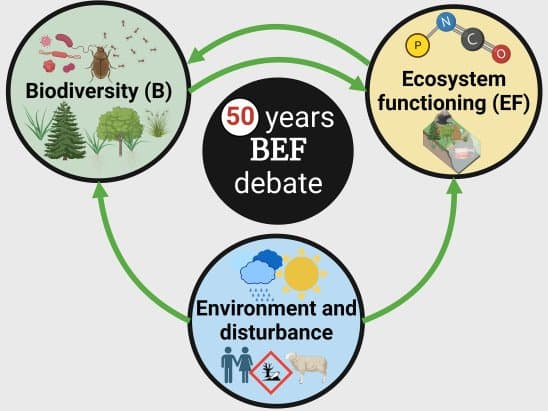
Connecting the Dots between Biodiversity, Ecosystem Function and Ecosystem Services
For many years, research on biodiversity, ecosystem functioning, and the services ecosystems provide to humans has progressed along parallel but often disconnected tracks. This fragmentation has limited our ability to fully understand how changes in biodiversity ultimately affect human well-being.
In 2022, a team led by Sarah R. Weiskopf published a significant paper in BioScience titled “A Conceptual Framework to Integrate Biodiversity, Ecosystem Function, and Ecosystem Service Models.” This work provides a much-needed roadmap for integrating these three domains into a coherent, unified approach.
The Three Domains and Why Integration Matters
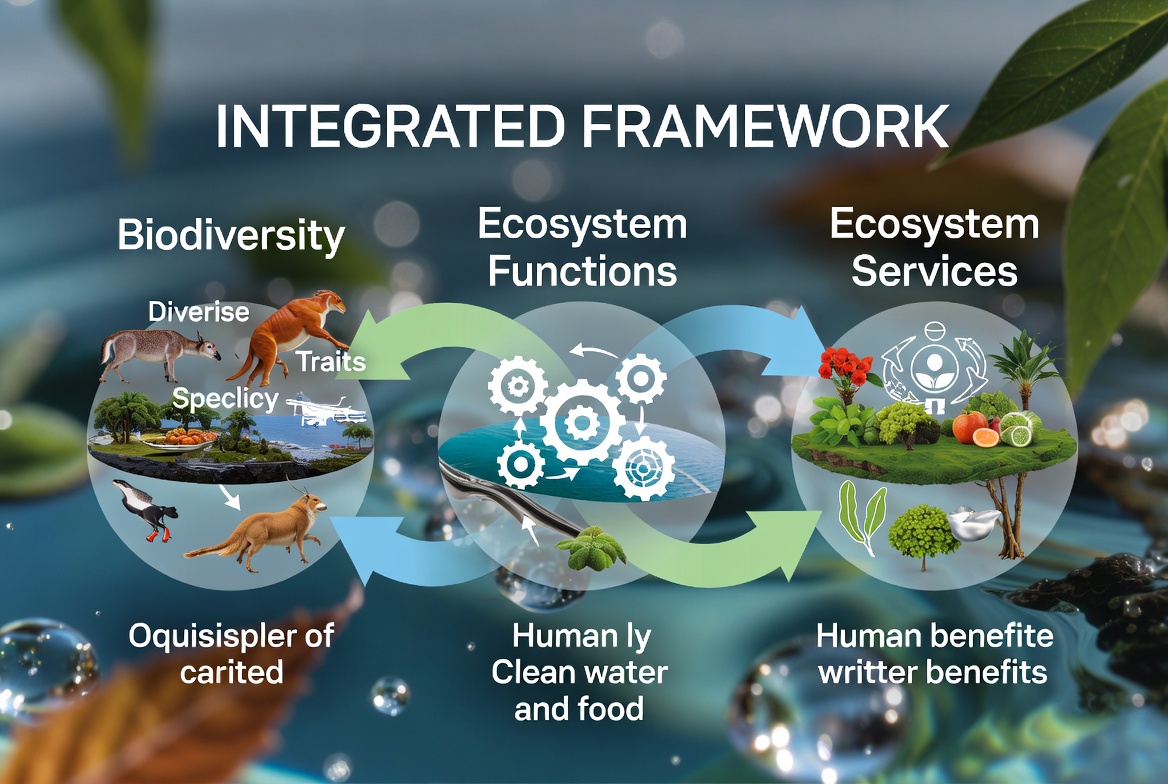
Biodiversity Models — Focus on species distributions, richness, composition, functional traits, and genetic diversity.
Ecosystem Function Models — Examine processes such as primary productivity, nutrient cycling, decomposition, pollination, and water filtration.
Ecosystem Service Models — Translate functions into benefits for people (e.g., food production, climate regulation, clean water, recreation, and cultural values).
Previous attempts to link them were often simplistic or incomplete. The new framework proposes two main pathways for integration:
Pathway 1: Empirical biodiversity-ecosystem function (BEF) relationships → ecosystem services
Pathway 2: Trait-based approaches that directly link functional characteristics to both functions and services
Core Elements of the Weiskopf Framework
The framework emphasizes several key principles:
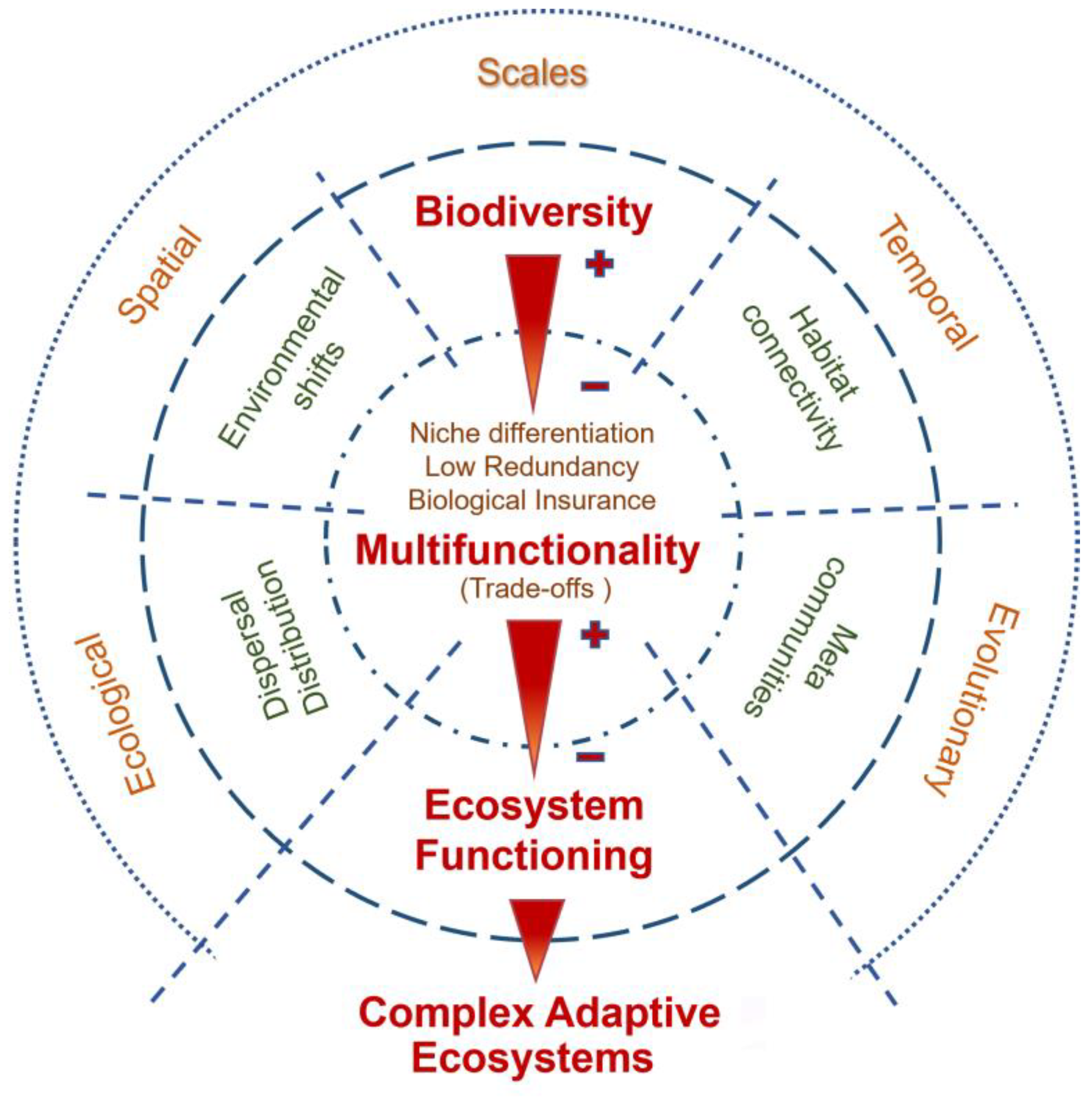
Multifunctionality: Ecosystems perform many functions simultaneously. Biodiversity often enhances the number and stability of these functions.
Context Dependency: The strength of biodiversity-function-service relationships varies across ecosystems, spatial scales, and environmental conditions.
Feedback Loops: Changes in services can feed back to influence biodiversity (e.g., over-harvesting reduces species diversity).
Cross-Scale Interactions: Processes operating at local, landscape, and global scales interact in complex ways.
Uncertainty and Variability: Explicit recognition of non-linear responses, thresholds, and tipping points.
The authors stress that functional traits and functional diversity (building on Cadotte’s earlier work) serve as powerful “currency” for linking the three domains.
Real-World Evidence Supporting the Framework
Several studies align strongly with this integrative approach:
Urban Greenspaces (Fan et al., 2023): Soil biodiversity strongly supports multiple ecosystem functions (nutrient cycling, carbon storage, water retention) in cities, directly contributing to urban ecosystem services.
Coastal Lagoons (Rodrigues-Filho et al.): Biodiversity drives ecological functions that translate into tangible services such as fisheries, water purification, flood protection, and recreational value for local communities.
River Ecosystems (Sabater et al., 2023): Extreme weather events disrupt both biodiversity and key functions, with clear downstream effects on services like clean water provision and fisheries.
Mountain Microbiomes (Wang et al., 2022): Microbial diversity in high-elevation ecosystems plays critical roles in carbon and nutrient cycling under climate change pressures.
These case studies demonstrate that the relationships are not theoretical — they have measurable consequences for nature and people.
Practical Applications
The framework has strong potential for:
Conservation Planning: Prioritizing areas that deliver high multifunctionality and multiple services.
Restoration Projects: Designing interventions that target key functional traits rather than just species numbers.
Environmental Impact Assessments: Better prediction of how development projects affect both ecological functions and human benefits.
Corporate Biodiversity Strategies (linking to Kennedy et al., 2023): Companies can move beyond simple metrics to measure impacts on functions and services using resilience-based approaches.
Policy and Economic Valuation: More accurate accounting of the true economic costs of biodiversity loss (as highlighted in recent economic studies such as Giglio et al.).
Challenges in Implementation
Data Gaps: Many regions (including parts of South Asia and developing countries) lack detailed trait and function data.
Complexity: Integrating models across disciplines requires collaboration between ecologists, economists, social scientists, and modelers.
Scale Mismatches: Biodiversity data is often local, while service benefits can be regional or global.
Non-linear Dynamics: Ecosystems can show sudden shifts that are difficult to predict.
Despite these challenges, the framework provides a structured way to address them systematically.
The Bigger Picture: Complex Adaptive Systems Perspective
When combined with complex adaptive systems thinking (Correia & Lopes, 2023), the Weiskopf framework becomes even more powerful. It recognizes that ecosystems are dynamic, self-organizing systems with emergent properties, feedbacks, and adaptability — not simple input-output machines.
This combined view is essential for understanding resilience under global change, including extreme events and multiple stressors.
Conclusion
The conceptual framework by Weiskopf and colleagues marks an important maturation in ecological science. By explicitly linking biodiversity, ecosystem functions, and services, it moves us closer to the holistic understanding needed to address today’s environmental crises.
For researchers, this framework offers clear pathways for future studies. For practitioners and policymakers, it provides a more reliable foundation for decisions that affect both nature and human societies. For businesses, it supports better measurement and management of biodiversity impacts.
Ultimately, this integration reminds us that protecting biodiversity is not just an environmental issue — it is fundamental to sustaining the life-support systems upon which all human prosperity depends.